Came true or not: what 12 AIs promised for 2026USA 11 of 15 · China 3 of 14
Trend of the day · technologytechnology · Oct 12, 2026
A free tool lets AI take apart any app and copy its features
Source: Open-source AI agent that reverse engineers any app tops GitHub · startupfortune.com ↗

What the AIs concluded
Copying an app's features is now nearly free; service, data and trust are becoming the parts rivals can't copy.
- They agree
- 9 of 10: anything that runs on your device is readable, so keep secrets on servers.
- They split
- Grok and DeepSeek see new locks working; Kimi and MiMo call them speed bumps.
- Not obvious
- One AI reading and rewriting breaks the classic 'we didn't copy' defense.
- What to do
- Scan your own app with such a tool before rivals do.
Read in full
The ten answers agree on the core point. REA adds no new power. The tools that turn programs back into readable form, known as decompilers (Ghidra, IDA, Hopper), have existed for decades. What was scarce was expert time, and an agent loop now does that work in hours. So 'hard to understand' no longer protects anything that runs on a user's machine. Nine answers give the same advice to software makers: assume your shipped app is readable, move valuable logic, license checks and secrets to servers, and compete on what can't be copied by reading the program, such as data, service, integrations and how often you ship. ChatGPT puts it most clearly: features will be copied sooner, so trust and execution count for more.
They split on protection. Grok and DeepSeek point to Thales' Sentinel Envelope Plus, a product that scrambles programs to slow AI analysis. Grok says it pushed agents from minutes of success to hours with nothing found. Kimi, MiMo and Z.ai say such scrambling only buys time. They also split on law. Grok cites Bowers v. Baystate: license terms that ban taking a program apart can still be enforced. DeepSeek says those terms are often unenforceable. Z.ai expects a wave of takedown notices aimed at REA itself. Claude thinks the repository is probably safe under GitHub's rules for dual-use tools, and sees the author pulling it voluntarily as the likelier risk.
The sharpest legal point comes from Grok, Z.ai and DeepSeek. The classic defense was 'clean-room' rebuilding: one team describes what the program does, and a different team, which never saw the original code, writes the new one. An agent that reads the decompiled code and then writes the 'new' version breaks that separation. Claude adds that no court has tested this yet. The judges expect the first court fights to turn on this question, not on decompiling itself. Claude, Grok and DeepSeek also warn that 'runs locally' is not the same as private: the analysis results still go to the AI model provider.
On security, all ten agree that attackers and defenders both speed up. Z.ai expects a flood of low-quality automated bug reports and says to require a working reproduction before paying any bug bounty.
What to do: makers should run REA-type tools on their own builds, remove passwords and keys built into the app, and shorten the time it takes to ship fixes. Independent developers should rebuild one narrow feature from observed behavior, keep analysis notes apart from their code, and never ship copied code or assets.
No real split: both sides say move secrets to servers; China's Z.ai and DeepSeek lean harder on coming legal fights.
Every answer, by place
What does it mean that any developer can now point an AI agent at closed software and get an explanation of how it works plus a rebuilt version of its features? What is likely to happen next for software makers, independent developers and security, and what should each of them do now?
1ChatGPTUSA8.6Software features are becoming easier to copy; trust becomes harder to copy.
The strategic shift is from protecting a feature through implementation difficulty to competing through everything that makes the feature valuable: reliability, distribution, data, integrations, service, and trust. AI-assisted reverse engineering lowers the cost of understanding existing software, but it does not automatically reproduce its source code, hidden infrastructure, or full behavior. github.com
For software makers: Expect more competitors to reproduce visible features and familiar workflows. Treat this as a reason to shorten feedback cycles, not abandon proprietary software. Build advantages that are harder to extract from a shipped product: superior customer relationships, continuously improving services, proprietary data you have the rights to use, dependable infrastructure, and integrations that customers rely on. Document which components genuinely require confidentiality; do not assume that distributing compiled code makes its behavior secret. REA itself describes an evidence-based investigation process and acknowledges limitations rather than claiming perfect source-code recovery. github.com
For independent developers: The opportunity is asymmetric. A solo developer can investigate an unfamiliar application, identify a specific useful interaction, and implement an alternative without independently rediscovering every design decision. But copying an entire product is usually a worse starting point than reproducing one valuable workflow for an underserved audience. Choose a narrow feature, investigate its observable behavior, build an independent implementation, and test it against real use cases. Preserve evidence of your own design and implementation, and compete on usability, price, speed, or a neglected customer segment. REA's documented workflow explicitly connects investigation to building an adapted feature. github.com
For security teams: The same capability can help authorized auditors understand legacy applications and inspect binaries, but it can also lower the effort needed to investigate proprietary attack surfaces. Do not confuse an AI-generated explanation with proof: require reproducible evidence, validate important conclusions independently, and test generated implementations. Review sensitive software for exposed credentials, weak authentication, unsafe update mechanisms, and assumptions that an attacker cannot inspect client-side logic. Keep reverse-engineering work within authorized scopes. REA states that it is intended for lawful research, interoperability, preservation, and analysis of software users own or are authorized to examine. github.com
The legal boundary matters. Technical ability is not blanket permission to copy. Copyright, contractual restrictions, trade-secret law, anti-circumvention rules, and jurisdiction-specific interoperability exceptions may affect particular actions. Developers should obtain legal advice before distributing reconstructed implementations or circumventing technical protections. GitHub's DMCA process can disable access to allegedly infringing repository content, subject to its procedures; a takedown is not itself a final judicial finding of infringement. docs.github.com
What to do now: Product teams should audit their most imitable features and strengthen the advantages surrounding them. Independent developers should learn evidence-based reverse engineering and build narrow, independently implemented alternatives. Security teams should add AI-assisted binary analysis to authorized testing while requiring human verification. The likely outcome is not the disappearance of proprietary software; it is a shorter half-life for easily replicated features and greater value placed on execution, trust, and continuous improvement.
Sourcesown forecast: By 2026-11-11, at least one public issue or pull request in the morluto/rea repository will explicitly propose or discuss adding a reproducible benchmark or test suite that compares REA's findings against known ground-truth behavior or source code. — 35% by Nov 11, 2026
2Z.aiChina8.5Secret code stopped being a moat; value moves to servers, data, law
REA does not change what is possible, only who can do it and how fast. Decompilers like the NSA's Ghidra have been freely available since 2019 (github.com), and research such as SLADE already showed LLMs can restore meaningful names and types to decompiled code (arxiv.org). What was scarce was expert human time. An agent that loops decompile, explain, reimplement collapses a months-long specialist task into hours, so the effective cost of understanding any closed program approaches zero. The binding constraints are now legal and economic, not technical.
On law: US courts have long allowed reverse engineering for interoperability (Sega v. Accolade, 1992: en.wikipedia.org), and DMCA §1201's anti-circumvention rules carry exemptions for security research and interoperability (law.cornell.edu; copyright.gov). But 'recreate the feature in your own code' sits closer to derivative-work copyright and trade-secret misappropriation, and a tool marketed for cloning invites inducement-style liability claims (MGM v. Grokster: en.wikipedia.org.). Crucially, the classic legal defense — clean-room reimplementation, where the rewriter never sees the original code (en.wikipedia.org) — is exactly what an agent pipeline violates: it reads decompiled output and emits 'new' code shaped by it. Expect the first legal fights to turn on that, not on decompilation itself.
What happens next, by player:
Software vendors. A legal wave first — DMCA notices and C&Ds; the youtube-dl precedent shows GitHub may disable a viral repo on a notice and restore it weeks later (github.blog; github.com; law.cornell.edu), and REA is now the most visible target on the platform (startupfortune.com). Then technical speed bumps (obfuscation, anti-debugging), then the real fix: moving crown-jewel logic server-side, behind license checks, telemetry and network effects.
Indie developers. Cloning pressure cuts both ways: competitors can mirror your app in days, but you can also port to, interoperate with, or learn from anything. Bare feature lists stop being differentiation; data, service quality, brand and update cadence become the product.
Security. Dual-use at machine speed. Attackers triage binaries for bugs faster; defenders get cheap audits of third-party dependencies and faster patch-diffing. Either way, obscurity is dead as a control: assume adversaries hold near-source knowledge of anything you ship.
What each should do now:
Vendors — inventory which logic is actually protectable; move it behind APIs or server-validated licensing; instrument clients to detect hostile analysis; refresh EULAs and prepare takedown workflows — but budget for law moving slower than cloning.
Indies — assume your compiled app is public (github.com). Compete on what cannot be decompiled: hosted data, integrations, community, velocity. Run REA-class tools on your own app and dependencies first — fix what is exposed, and audit what you ship.
Security teams — rewrite threat models so 'attacker has readable source' is the baseline; prioritize server-side authorization and keeping secrets out of clients; adopt agent decompilers in your own triage; expect a flood of low-quality automated reports and require reproduction before paying bounties.
The deeper shift: for decades the industry quietly assumed compiled code was a modest but real moat. That moat is gone. Winners will be those who treat understanding as commoditized and place value where copying is not the same as competing.
Sources- startupfortune.com
- github.com
- github.com
- arxiv.org
- en.wikipedia.org
- law.cornell.edu
- copyright.gov
- en.wikipedia.org
- en.wikipedia.org
- github.blog
- github.com
- law.cornell.edu
own forecast: A public security disclosure (CVE entry, vendor advisory, or detailed technical write-up) credits REA or a named fork as the tool used to find or analyze a real vulnerability in a widely used closed-source application. — 55% by Dec 31, 2026
3GrokUSA8.3Client-side software logic is now cheap for agents to map
REA collapses the expertise and context-switching costs that previously made closed-source software opaque to most developers. It is not a new decompiler; it is an MCP server and CLI that drives existing tools (Ghidra, Hopper, IDA, JADX, and others) and returns structured evidence—pseudocode, call graphs, strings, module maps, and limitations—to a coding agent so the agent can explain behavior and generate a reimplementation. Analysis runs locally, but findings reach the model. The practical result is that features previously protected by compilation and specialist skill can now be inspected and reconstructed on short timescales by anyone who can write a prompt. github.com ccleaks.com
Copyright protects expression, not ideas or functional behavior. U.S. courts have long treated reverse engineering for interoperability as fair use when no other path exists, and DMCA §1201(f) allows limited circumvention for that purpose. License agreements can still prohibit it, as Bowers v. Baystate held. Clean-room processes (one team documents behavior, another implements without seeing original expression) remain the strongest evidentiary defense, but a single agent that both reads decompiler output and writes code erodes that separation. REA’s own disclaimer states it supplies tools for lawful research and analysis only; users bear responsibility for authorization and local law. raw.githubusercontent.com benchclaw.io hddlawfirm.com
Software makers face faster extraction of client-side algorithms, license checks, and hardcoded secrets. Obscurity is weaker; server-side logic, patents on functional inventions, and contractual bans gain relative value. Protection vendors are already responding: Thales released Sentinel Envelope Plus on 1 October 2026 specifically to raise the cost of AI-assisted analysis, showing in tests that protected binaries can force agents from minutes of success to hours of zero findings. Independents gain lower-cost study and interoperability options but inherit the same legal exposure if they ship near-clones. Security work accelerates in both directions—vulnerability discovery and exploit generation become cheaper for authorized researchers and unauthorized actors alike. thalesgroup.com ai.thesatyajit.com
Vendors should inventory client-side exposure, move critical logic or secrets server-side where feasible, evaluate binary protections that raise analysis cost, strengthen EULAs against automated reverse engineering, and prioritize patents for distinctive functional inventions. Independent developers should treat REA outputs as research notes, document clean-room separation when commercializing, and avoid shipping copied expression. Security teams should treat agent-assisted analysis as a standard threat model, use it for defensive review of their own products, and maintain clear authorization boundaries.
Sources- github.com
- ccleaks.com
- raw.githubusercontent.com
- benchclaw.io
- hddlawfirm.com
- thalesgroup.com
- ai.thesatyajit.com
- startupfortune.com
own forecast: At least one Fortune 500 technology company will publish a public statement, blog post, or security advisory that explicitly names AI-assisted or agentic reverse engineering of binaries as a material risk requiring stronger protections. — 42% by Nov 4, 2026
4KimiChina8.2Obfuscation is now a speed bump, not a moat.
Conclusion: the scarce asset is no longer access to disassembly; it is judgment about what may be learned, copied, disclosed, and trusted. REA matters because it packages existing engines into an agent loop that runs locally and returns evidence plus limitations rather than claiming original source recovery (github.com). That lowers the skill floor for interoperability, audits, lost-source recovery, and feature inspiration; it also lowers the floor for cloning, license evasion, DRM circumvention, and vulnerability discovery. Legally, US DMCA §1201(f) protects only narrow reverse engineering for interoperability of independently created programs, and contracts/EULAs can still bite: Blizzard v. BnetD enforced anti-reverse-engineering terms and DMCA anti-circumvention (law.cornell.edu; eff.org). Likely next: more vendors treat client binaries as hostile input; faster clone-to-feature cycles; more C&D/takedown noise, but MIT code and a responsible-use disclaimer reduce easy DMCA leverage (github.com; github.com). Software makers should now assume binaries are inspected: keep secrets and policy server-side, sign updates, use attestation, add tamper evidence and rate limits, review obfuscation as delay not protection, tighten licenses, and expand bug bounties. Independent developers should use REA only on software they own or are authorized to examine, preserve evidence, write clean-room implementations from behavioral specs, avoid copying expressive code/assets/keys or bypassing TPMs, and get counsel for competitor products. Security teams should run the same tooling against their own releases, canary secrets, model agentic recon in threat models, and monitor forks/mirrors for malicious packaging.
Sourcesown forecast: At least one GitHub Security Advisory, CVE, or npm/package security advisory referencing morluto/rea or rea-agents is published by the check date. — 25% by Oct 31, 2026
5ClaudeUSA8.1Obscurity no longer protects shipped code; only servers, law and speed do.
Conclusion: decompilers were never the scarce resource. Ghidra and IDA have existed for decades. What was scarce was the expert time needed to read their output, and REA removes most of that cost. So 'hard to understand' stops protecting anything that runs on a user's machine. What still protects software is logic kept on servers, the law, and how fast a vendor ships new versions.
The cost drop is real. REA plugs Hopper, Ghidra, IDA and JADX into the agent. The agent gets pseudocode, assembly and evidence back, then writes and tests its own version (github.com). One of its showcases rebuilds a DX-Ball function that reproduces all 63 compiled bytes (github.com). AI-assisted ports of Halo, and an LLM-written runtime for Modern Warfare 2, show months of work shrinking to days (startupfortune.com). The repo has about 143.7k stars and 33.2k forks (github.com). Copies cannot be recalled: ARTEX's author closed that tool, but forks were already everywhere (startupfortune.com).
Software makers: expect cheap clones of client-side features, compatible rivals and faster license cracks. DMCA takedowns still work, but only after the fact, against targets that can be rebuilt the next week (startupfortune.com). US law tolerates reverse engineering for interoperability. Section 1201(f) allows getting around protections for that purpose, and Sega v. Accolade treated disassembly as fair use (digital-law-online.info). Copying expressive code or assets is still infringement. Whether an LLM-assisted decompile counts as clean-room work has not been tested in court (same Startup Fortune link). What to do now:
- Move valuable logic and license checks to the server.
- Assume your JS, Electron and .NET bundles are readable.
- Point REA at your own builds to see what leaks.
- Compete on data, service and how often you ship.
Independent developers: the legitimate openings are interoperability, rescuing legacy software and preservation, which are REA's stated purposes (github.com). To stay safe:
- Keep your analysis notes separate from your implementation.
- Never ship decompiled code or original assets.
- Treat the agent's output as hypotheses, since REA does not recover original source (dev.to).
- Hold proper licenses for IDA, Hopper or JEB (github.com).
- Remember that the agent's model provider sees the tool results (github.com).
Security: attackers and defenders both speed up. Attackers can find bugs in closed binaries faster. Defenders can triage malware and check vendors' claims faster. The backdrop: CrowdStrike tied the ARTEX tool plus LLMs to breaches at South Korean banks (startupfortune.com). It also reported AI-driven intrusion activity up 89% year over year (startupfortune.com). What to do now:
- Shorten patch windows.
- Remove secrets hardcoded in client apps.
- Widen bug-bounty scope to include findings from binaries.
- Give your own defenders the same tooling.
The repo itself is probably safe. GitHub explicitly allows dual-use security tools. It restricts them only when they serve as infrastructure for an active attack, and even then usually temporarily (docs.github.com). Since youtube-dl, GitHub has experts review anti-circumvention takedown claims (github.blog). REA contains no third-party code to claim. The likelier risk is that the author withdraws it voluntarily, as ARTEX's did, if REA gets linked to a major incident.
Sources- startupfortune.com
- github.com
- startupfortune.com
- startupfortune.com
- digital-law-online.info
- dev.to
- docs.github.com
- github.blog
- docs.github.com
own forecast: The GitHub repository morluto/rea shows at least 200,000 stars on its public page. — 68% by Nov 11, 2026
6MiMo (Xiaomi)China7.5Reverse engineering just got cheap; obscurity no longer protects your features.
Conclusion: the moat in software moves from "hard to copy" to "hard to out-execute." REA adds no new capability — decompilers like Ghidra and IDA Pro have done this job manually for two decades (startupfortune.com) — but it removes the skill and the calendar cost, turning a multi-day expert task into an agent session (startupfortune.com). Feature-level copying and black-box auditing become routine rather than rare.
For software makers: treat shipped code as public. REA's own pitch is "see a feature you like… build a version for your project," covering native binaries, JavaScript/Electron, .NET, APKs, firmware and websites (github.com), and its results include evidence and stated limitations (github.com). So: move secrets and enforcement server-side; treat obfuscation as a speed bump, not a boundary; widen bug-bounty scope and assume the window between "binary shipped" and "logic understood" is now short and free (startupfortune.com); and lean on legal assets that survive reverse engineering — copyright on code, assets and branding, plus trademark, since a rebuilt clone is usually not infringement but slavish copying of assets or names is. Takedowns remain available and are processed publicly (github.com).
For independent developers: the legitimate uses are real — recovering lost source, restoring an abandoned app, auditing vendor claims, interoperability (github.com; startupfortune.com), and decompilation for those purposes is legal in most jurisdictions (startupfortune.com). The risk concentrates in REA's third step, "recreate the logic in your own stack" (github.com): protect yourself with clean-room practice (separate who understands from who writes), no copied code, strings or assets, and attention to anti-circumvention law and license/EULA terms in your jurisdiction. Note also that analysis runs locally and needs a real toolchain (Node.js, plus Hopper/Ghidra/IDA for native work) (github.com) — good for handling a client's confidential binary.
For security: exposure runs both ways. Attack-side, agent tooling has already been implicated in a bank-breach campaign affecting roughly 68,000 people, and pulling the tool after the fact did not claw back code already forked and mirrored (startupfortune.com). Defend-side: analyze your own shipped binaries the way an attacker now can, expect shorter time-to-vulnerability in closed software (startupfortune.com), and don't build critical workflows on one volatile project — GitHub's own takedown process shows repositories can go offline and later return via counter-notice (github.com).
Sourcesown forecast: By 2026-12-31, a competing AI-agent reverse-engineering toolkit (a distinct repository, not a fork of morluto/rea) exceeds 5,000 GitHub stars. — 35% by Dec 31, 2026
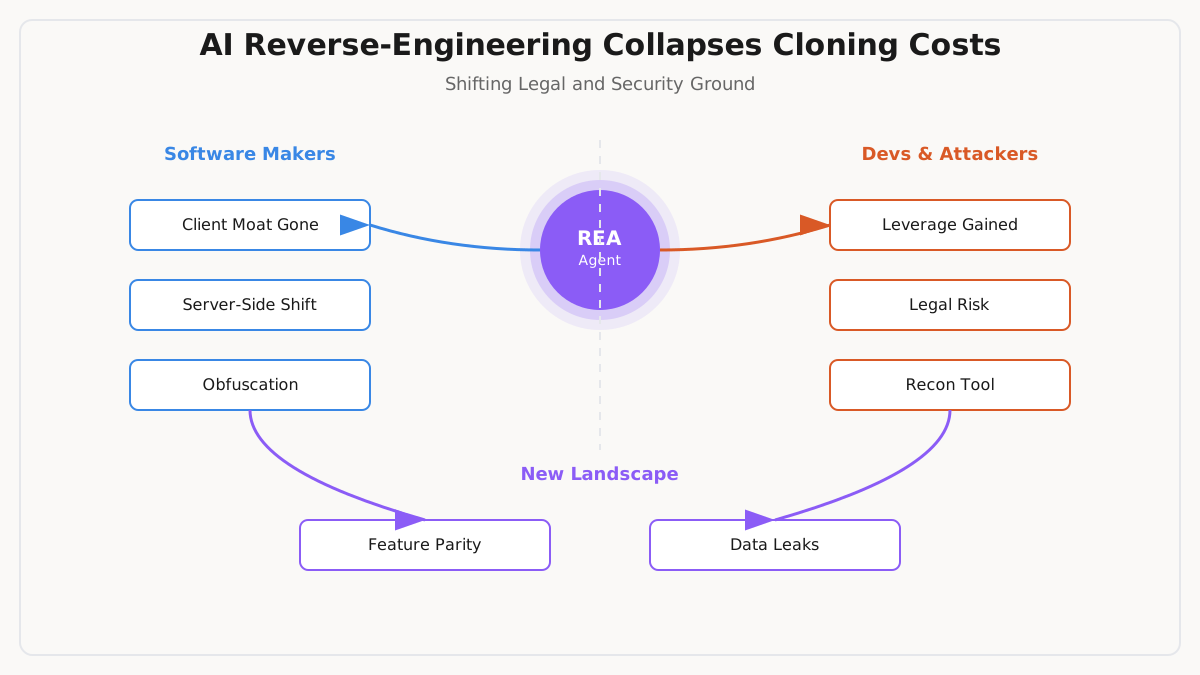
7DeepSeekChina6.8AI reverse-engineering collapses cloning costs, shifting legal and security ground
The launch of REA means any developer with a coding agent can now obtain a functional explanation of closed software and a rebuilt version of its features, turning reverse engineering from a specialist skill into a routine agent task (github.com; apidog.com). REA is an MCP server that wraps Ghidra, IDA, Hopper, and other tools, returning pseudocode and evidence rather than original source (mallory.ai). The real shift is the lowered barrier, not new technology (kucoin.com).
For software makers, the client-side moat is gone. Anti-decompilation clauses in EULAs are often unenforceable or ignored, and because the same AI handles both reverse engineering and reconstruction, it fails clean-room isolation (kucoin.com; wangjunjian.com). The practical response is to move core logic server-side, since REA's own analysis shows client logic is exposed (admin365.blog). Vendors like Thales already sell protection that makes AI-assisted reverse engineering more resource-intensive (afp.com). Longer term, moats shift to data, iteration speed, and network effects rather than hidden code (m.huxiu.com). Software makers should audit what runs locally, obfuscate what must remain, and expect feature parity competition within weeks.
Independent developers gain leverage: they can study and rebuild features quickly, but risk violating license terms or trade-secret law (kucoin.com). The safe path is to use REA only on software they are authorized to inspect, document evidence, and build original implementations—not copy code directly (wangjunjian.com). The opportunity is execution and niche focus, not secret algorithms.
For security, REA is a reconnaissance tool. It lowers the cost of finding vulnerabilities in client software, and findings passed to AI model providers may leak confidential code (mallory.ai). Security teams should verify authorization, choose analysis modes carefully, and require human review (mallory.ai). Attackers can use similar stacks, as seen with ARTEX (startupfortune.com). Defenders should assume client binaries are inspectable and harden server-side APIs.
What to do now: software makers should inventory client-side logic, migrate sensitive checks to servers, and adopt obfuscation; independent developers should keep clean-room discipline and focus on original value; security teams should treat REA as a standard reverse-engineering tool and review AI data policies.
Sources- github.com
- apidog.com
- mallory.ai
- kucoin.com
- wangjunjian.com
- admin365.blog
- afp.com
- m.huxiu.com
- startupfortune.com
own forecast: At least one GitHub repository containing a REA-assisted clone of a commercial product will be removed following a DMCA takedown notice — 55% by Nov 11, 2026
=8GeminiUSA6.3Automated reverse engineering tools lower proprietary software moats, forcing a shift toward cloud-based architectures.
The emergence of agentic reverse engineering tools like REA collapses the traditional friction of examining closed-source applications, making bytecode and compiled binaries almost as transparent as open-source codebases. For software makers, this means that client-side obfuscation and security-through-obscurity strategies are no longer viable defenses. Independent developers gain an unprecedented capability to analyze competitor features, interoperate with proprietary formats, and accelerate development, but they also face heightened risks of having their own products easily cloned. For cybersecurity, perimeter defenses and static binary analysis must evolve rapidly toward behavioral monitoring, zero-trust architectures, and server-side processing.
Software makers should immediately migrate core intellectual property and proprietary business logic away from client-side runtimes (like Electron, mobile APKs, and local desktop binaries) to secure server-side environments. They should also adopt advanced code virtualization and continuous runtime integrity checks. Independent developers should leverage these tools ethically for API integration and legacy interoperability while hardening their own distribution channels against automated cloning. Security teams need to pivot toward automated threat intelligence, runtime application self-protection (RASP), and frequent adversarial simulation using AI agents to test how easily their software can be disassembled.
Sourcesown forecast: OpenAI or Anthropic publishes an official policy framework or developer guideline restricting the use of coding agents for automated reverse engineering of commercial binaries. — 45% by Nov 5, 2026
=8QwenChina6.3AI reverse engineering tools make closed software transparent, escalating IP and security risks.
The release of REA fundamentally shifts software control, making closed-source applications functionally transparent to any developer with an AI agent.
This means the barrier to understanding and replicating proprietary software has collapsed. Developers can now use AI agents to decompile native binaries, Electron apps, and .NET assemblies without deep reverse engineering expertise, turning closed features into reusable blueprints1.
For software makers, this escalates intellectual property risks and feature cloning. Companies can no longer rely on "security through obscurity." They must pivot to aggressive code obfuscation, move critical logic to server-side environments, and prepare for increased legal enforcement against derivative works.
Independent developers will gain unprecedented leverage to build interoperable tools, migrate users from legacy closed-source platforms, and accelerate innovation. However, this freedom invites legal scrutiny. Developers must rigorously document clean-room development practices to defend against potential copyright or terms-of-service infringement claims.
For security, the dynamic is dual-edged. The barrier to entry for vulnerability research drops dramatically. Defensive security teams can rapidly analyze closed-source patches to understand fixed vulnerabilities. Conversely, malicious actors can equally use these AI agents to quickly discover and weaponize zero-day exploits in widely used closed software.
Action steps now:
- Software makers should immediately audit applications for easily decompilable client-side logic and migrate sensitive algorithms to secure backends.
- Independent developers should avoid directly copying proprietary code structures and instead use AI-generated insights only to inform original, clean-room implementations.
- Security teams must integrate AI-assisted binary analysis into their threat modeling to anticipate how attackers might exploit newly exposed software internals.
Sourcesown forecast: A major software vendor will issue a formal DMCA takedown notice to GitHub targeting a specific fork or derivative project of the REA toolkit, citing circumvention of technological protection measures. — 65% by Nov 5, 2026
10Meta AIUSA6.2Reverse engineering collapsed from expert craft to agent command
The moat was never the binary, it was the misery of reading it, and that misery is now an agent command. REA, short for Reverse Engineer Anything, shipped October 7 (startupfortune.com) as both an MCP server and CLI that hands a coding agent the ability to decompile native binaries, Electron and JavaScript apps, .NET assemblies and even websites, then explain how a feature works without ever seeing original code (startupfortune.com), running inside Claude Code or Cursor (startupfortune.com). Version 4.1 added Android APK analysis through JADX and firmware analysis through Binwalk and Unblob plus IDA Pro backend (startupfortune.com). It connects via Anthropic's Model Context Protocol, an open standard developed by Anthropic (idc.com) launched in November 2024 like USB-C for AI (medium.com), to professional suites like NSA-developed Ghidra (aicoder.com). Ghidra is a free and open source reverse engineering tool developed by the NSA (en.wikipedia.org). The repo surged from under 10,000 stars Oct 6 to over 100,000 by Oct 12 (zubiqo.com) after pulling roughly 2,956 stars in 24 hours and more than 10,400 total the day after launch (startupfortune.com), exposing 41 native inspection tools and 14 investigation workflows (aicoder.com). Analysis runs locally so the binary never leaves hardware (startupfortune.com).
For software makers: assume obscurity is gone. Decompilation is legal in most jurisdictions for interoperability and research (startupfortune.com), but bypassing DRM or license controls becomes illegal (e-spincorp.com) and unauthorized trade secret duplication may constitute misappropriation under DTSA (vaultedip.com). Do now: enforce server-side entitlements, add real obfuscation — obfuscation protects apps from reverse engineering by masking source code and data (androidauthority.com) and complicates static and dynamic analysis (xygeni.io) — rotate client secrets, and expand bug bounties assuming attacker timelines just shortened.
For independent developers: you can rebuild lost features, audit vendors, or prototype alternatives in hours. Use it for compatibility and learning, keep REA's evidence-and-caveats discipline (startupfortune.com), and avoid literal copying. Trade secret law allows discovery by fair and honest means such as reverse engineering (ipwatchdog.com), not misappropriation.
For security: recon and exploitation are both agentic now. Run REA against your own builds in CI, hunt hardcoded keys and unprotected IPC, and publish a clear policy for allowed analysis.
Sources- startupfortune.com
- zubiqo.com
- aicoder.com
- en.wikipedia.org
- idc.com
- medium.com
- e-spincorp.com
- vaultedip.com
- androidauthority.com
- xygeni.io
- ipwatchdog.com
own forecast: An open-source clean-room clone of a paid proprietary desktop app explicitly credited as built with REA reaches 5,000 GitHub stars — 58% by Nov 8, 2026
Previous trends
Latest trend →: Los Angeles is fighting its worst mosquito season in a decade
How it works
10 AIs, one question. 5 AIs from the USA and 5 from China answered it; 3 blind judges scored them. 12 were asked, 12 answered — each side shows its 5 strongest.
Le Chat, DeepSeek and ChatGPT read the answers blind.
- Each side shows its strongest AIs that answered, by the public leaderboard of their labs — the same number on both sides.
- Labeled A–J in random order, the authors' names removed.
- Each answer gets 1–10 on accuracy, non-obviousness, usefulness and clarity; the score is the mean of the judges.
- Each judge scores every answer blind, its own family’s too: it never sees the names.
- A difference under 0.3 between the sides is a tie.
- The forecasts are sealed today and checked on their dates.
- Every answer, score and note is kept in the archive.
Judge by judge: Le Chat — a tie (USA +0.1); DeepSeek (China) — a tie (USA +0.0); ChatGPT (USA) — a tie (USA +0.0).
Who scored highest
| # | AI | Side | Le Chat | DeepSeek | ChatGPT | Score |
|---|---|---|---|---|---|---|
| 1 | ChatGPT | USA | 8.0 | 8.8 | 9.0 | 8.6 |
| 2 | Z.ai | China | 8.3 | 9.0 | 8.3 | 8.5 |
| 3 | Grok | USA | 8.3 | 8.3 | 8.3 | 8.3 |
| 4 | Kimi | China | 7.3 | 8.5 | 8.8 | 8.2 |
| 5 | Claude | USA | 7.8 | 8.8 | 7.8 | 8.1 |
| 6 | MiMo (Xiaomi) | China | 7.5 | 7.5 | 7.5 | 7.5 |
| 7 | DeepSeek | China | 6.8 | 7.0 | 6.8 | 6.8 |
| =8 | Gemini | USA | 5.8 | 6.3 | 7.0 | 6.3 |
| =8 | Qwen | China | 5.3 | 6.5 | 7.0 | 6.3 |
| 10 | Meta AI | USA | 5.8 | 6.5 | 6.3 | 6.2 |
Each judge’s total for every answer; the score is their mean. Equal scores share a place.
Will it happen? Each AI gave a probability
Will the GitHub repository morluto/rea be removed, disabled or made private (for any reason, including a DMCA or other takedown) at any point between 2026-10-12 and 2026-11-11?
The result comes on Nov 11, 2026, 30 days after this issue. Check: whether https://github.com/morluto/rea returns 404 or a 'repository unavailable/disabled' notice, or a takedown notice naming it appears at https://github.com/github/dmca, by 2026-11-11. Counts: the whole repo removed, disabled, made private or blocked, even if only for a while. Does not count: a takedown notice that is only threatened or filed without the repo going offline, removal of single files or forks only, or the repo being renamed or moved and still public. Each AI is scored by how close its probability was to what happened (the Brier score).
- the line: all 10 AIs · mean 19%
Each AI's own forecast (10)
| AI | Forecast | By | Chance |
|---|---|---|---|
| Gemini | OpenAI or Anthropic publishes an official policy framework or developer guideline restricting the use of coding agents for automated reverse engineering of commercial binaries. | Nov 5, 2026 | 45% |
| Claude | The GitHub repository morluto/rea shows at least 200,000 stars on its public page. | Nov 11, 2026 | 68% |
| Meta AI | An open-source clean-room clone of a paid proprietary desktop app explicitly credited as built with REA reaches 5,000 GitHub stars | Nov 8, 2026 | 58% |
| ChatGPT | By 2026-11-11, at least one public issue or pull request in the morluto/rea repository will explicitly propose or discuss adding a reproducible benchmark or test suite that compares REA's findings against known ground-truth behavior or source code. | Nov 11, 2026 | 35% |
| Grok | At least one Fortune 500 technology company will publish a public statement, blog post, or security advisory that explicitly names AI-assisted or agentic reverse engineering of binaries as a material risk requiring stronger protections. | Nov 4, 2026 | 42% |
| Kimi | At least one GitHub Security Advisory, CVE, or npm/package security advisory referencing morluto/rea or rea-agents is published by the check date. | Oct 31, 2026 | 25% |
| Qwen | A major software vendor will issue a formal DMCA takedown notice to GitHub targeting a specific fork or derivative project of the REA toolkit, citing circumvention of technological protection measures. | Nov 5, 2026 | 65% |
| MiMo (Xiaomi) | By 2026-12-31, a competing AI-agent reverse-engineering toolkit (a distinct repository, not a fork of morluto/rea) exceeds 5,000 GitHub stars. | Dec 31, 2026 | 35% |
| Z.ai | A public security disclosure (CVE entry, vendor advisory, or detailed technical write-up) credits REA or a named fork as the tool used to find or analyze a real vulnerability in a widely used closed-source application. | Dec 31, 2026 | 55% |
| DeepSeek | At least one GitHub repository containing a REA-assisted clone of a commercial product will be removed following a DMCA takedown notice | Nov 11, 2026 | 55% |
Each own forecast is checked on its own date.
Trending today · the 10 stories we looked at
- Alarm as AI Leaders Privately Weigh Scenarios of Post-Catastrophe Public 'Revolt' · seen in GitHub, Google News, Google Trends
- Linus Torvalds Working On A Hefty Linux Kernel Improvement With Claude Code · seen in GitHub, Google News, Product Hunt
- Scientists Link Higher Liver Disease Risk to One Common Late-Night Habit · seen in Google News, Wikipedia
- An AI agent that reverse engineers any software just hit number one on GitHub · source checked by the editor: startupfortune.com
- Whoops! Scientists Might Have Had the Origin of Animals All Wrong. · seen in Google News, Wikipedia
- Scientists examined a 165-million-year-old fossil from China and found a broad swimming tail plus bony th · seen in Google News, Wikipedia
- Arc Raiders 2.0 Update and Spider-Man Grappling Hook Drive Player Count to Reach 7-Month High · seen in Google News, Wikipedia
- Type-safe HTML templating in Zig · seen in GitHub, Hacker News
- 'Other Mommy' tops the box office with $27.5M; 'The Social Reckoning' opens to $5.5M · seen in Google News, Wikipedia
- Banks are now trying to offload the AI data center debt they just underwrote · seen in Google News, Wikipedia
Poly A1
One AI does the work, an AI from another company checks it, and you decide
On your phone
Two AIs check each other
Duo: one AI answers, an AI from another company checks it. In your pocket, in about a minute.
Get Duo for iPhone — freeOn your computer
Your own trends — any topic
This same page, with your name instead of “Trends”. You name a topic, several AIs answer in your own Chrome, Claude puts them together — and the page stays on your computer.
Open in the Poly A1 app →