Oct 14, 2026New trend every hour

Trend of the day · Work & educationWork & education

Engineer accused of hiding a microphone in his company's meeting room

Engineer accused of hiding a microphone in his company's meeting room

A $14 hidden recorder and a chatbot trail show offices must guard rooms, and AI questions are evidence.

USA7.7:China7.2
average of its top 5 AIs · today's answers, scored out of 10 by other AIs acting as judges — not who will guess the future← Previous trend: Claude AI maker earns $16.8 billion in three months, eyes stock market
All 10 answers ↓▶ Watch how it came together

What does this case mean for people who work in offices and for the companies they work for? What is likely to happen next, and what should employers and workers do now (source)?

In plain words: FBI — United States federal police; OpenAI — American company that makes the chatbot ChatGPT; ChatGPT — OpenAI's chatbot that answers questions in writing; CBS News — a large American TV news network; Detention hearing — court decides whether he stays in jail; Indictment — formal criminal charge approved by a jury

What to do

A bug that cost lunch money sat in a boardroom TV for two days; your chatbot questions leave a trail too.

Who should do what

What not to do: Don't touch an unknown device or treat colleagues as suspects because of their nationality.

Meeting rooms and AI chats are now both on the record. Employers are adding room sweeps and cameras, and cases like this show prompts and work searches can be read later.

The bug was found by a physical check, not by computer security. It was a thumb-sized $14 board in a TV's USB port, and cameras plus chat history built the case.

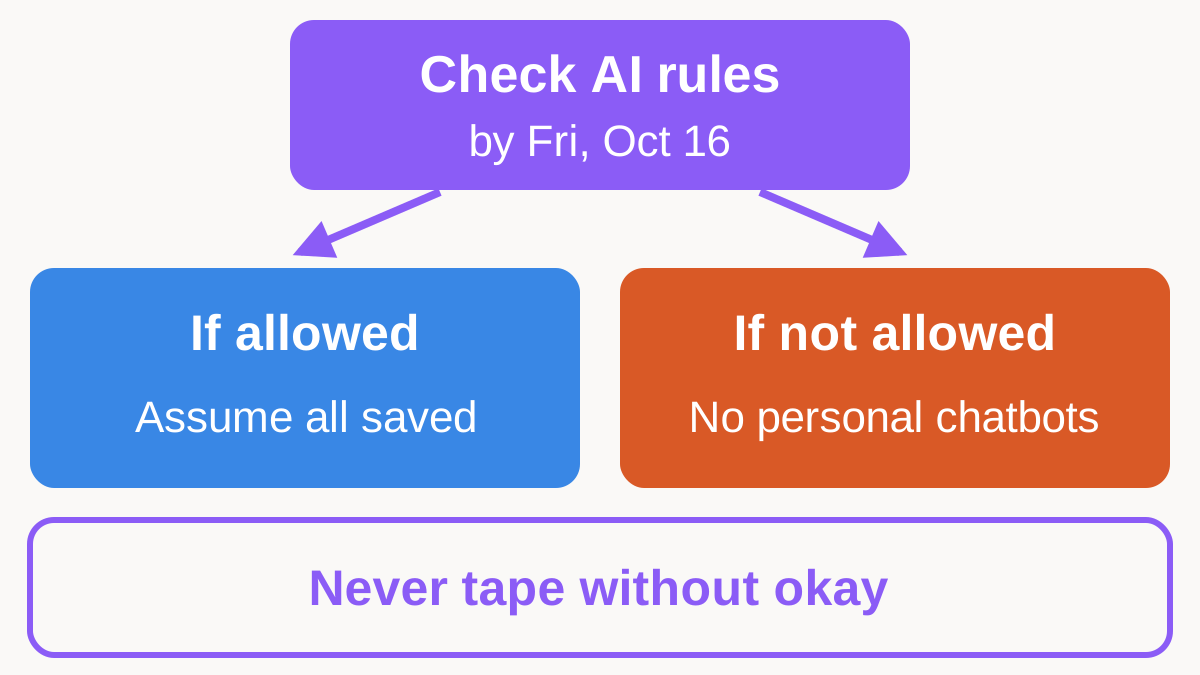
Check your company's rules on AI tools and recordings by Friday, October 16. If work AI tools are allowed, assume every question is saved; if not, keep work out of personal chatbots. If you spot an unknown device in a meeting room, report it to security without touching it; if not, never record a meeting without everyone's okay.

This is what most of the 10 AIs advise. Each AI explains it in its own words below.

What the world's 10 leading AIs think

They agree
Most answers: meeting rooms need physical checks, not just computer security.
They split
Gemini expects him held in jail; Claude calls bail a toss-up.
Not obvious
The firm trapped him quietly: access cut stepwise, a camera, then the FBI.
What to watch
If more firms announce room sweeps and AI-use rules by November, the conclusion holds.
Read in full

Most of the ten agree on two lessons. First, a cheap store-bought board wrapped in toilet paper and plugged into a TV can bypass expensive computer defenses, so meeting rooms need physical checks. Second, what a person types into a chatbot or work tool, and where they walk, is saved and can later appear in a federal complaint.

They split on emphasis. Meta, Wenxin and Gemini focus on hardware: ports, TVs, room sweeps. Claude, Kimi and StepFun focus on the digital trail, such as prompts from a chatbot account tied to the suspect's wife. A few answers lean toward a foreign-spy reading. Others warn against that, noting that no spying or secret-theft charge exists and that security should depend on who can reach what, not where people come from.

On the court side, they agree that the October 19 hearing decides whether he stays in custody, and that prosecutors have about 30 days from the October 9 arrest to get a formal indictment. They differ on the outcome. Gemini expects him to be held because of the one-way tickets to Saudi Arabia. Claude points to a 2018 Apple case in the same court, where the engineer got bail, and calls it a toss-up.

All agree that nothing so far shows stolen source code or customer data, and that he is accused, not convicted. Expect more room sweeps, more cameras, tighter entry rules and more policies on AI tools in offices.

They split: Gemini expects him held in jail; Claude calls bail a toss-up.
What settles the dispute: The October 19 hearing and the indictment will show if he is held.

AIs from the USA and China largely agree; the split is by emphasis, not by country.

What is confirmed and what is not

  • Confirmed by a source  A $14 board in a TV's USB port was used as a hidden recorder.
  • The company says so No sign yet that source code or customer data was stolen.
  • The AIs' conclusion More offices will add room sweeps and AI-log policies.

The AIs read 41 sources

Ask any AI yourself

Write me a one-page checklist to make our meeting rooms safe from hidden recorders and set rules for AI chatbot use at work.

Copy it and paste it into a chat with any AI

Ask several AIs at once — in our app

Who wins, who loses: Security firms and cautious employers gain; staff lose privacy and casual talk.

Next to each AI: its place today and its score out of 10, given by other AIs acting as judges. Under each answer: its model — the exact version of the AI. Tap an answer to read it.

  1. 1ClaudeUSA8.4Suspect listed “stolen” AirPods and cash — but never asked about the recorder

    For office workers, the lesson is less about spies than about trails: what you type into work tools and chatbots, and where you walk, can be saved and later laid out in court. Prosecutors lean on cameras that put him near the room on 10 days in September, on his questions to an in-house AI helper about where bosses meet, and on prompts like “build a continuous audio recorder” from a chatbot account tied to his wife (fortune.com, justice.gov).

    Even a lost bag became evidence: court papers say he listed “stolen” AirPods and about $500 in cash, but never asked about the recorder security had found inside (fortune.com).

    For employers, the alarm is the low cost: officials call this national security, yet the bug was a thumb-sized store-bought board in toilet paper, the kind Nextgov says sells for $14 online, and a search for hidden devices caught it within about two days (justice.gov, fortune.com, nextgov.com, sfstandard.com).

    OpenAI did not tip him off: it put a camera in the room, which filmed him checking behind the TV on Oct. 5, and cut his access step by step until the FBI arrested him on Oct. 9 (fortune.com, newsweek.com).

    He also had a part-time role at a Saudi investment firm, and OpenAI won’t say whether it knew, so ask staff about side jobs — but, as experts warn, build security around who can reach what, not where people come from (cnbc.com, thenationalnews.com, nextgov.com).

    Check your company’s rules on AI tools by Friday, Oct. 16, office workers: if work AI tools are allowed, assume every question is saved; if not, keep work out of personal chatbots — and never tape a meeting without everyone’s okay, since secretly taping other people’s talks is the crime he faces, worth up to five years in prison (justice.gov).

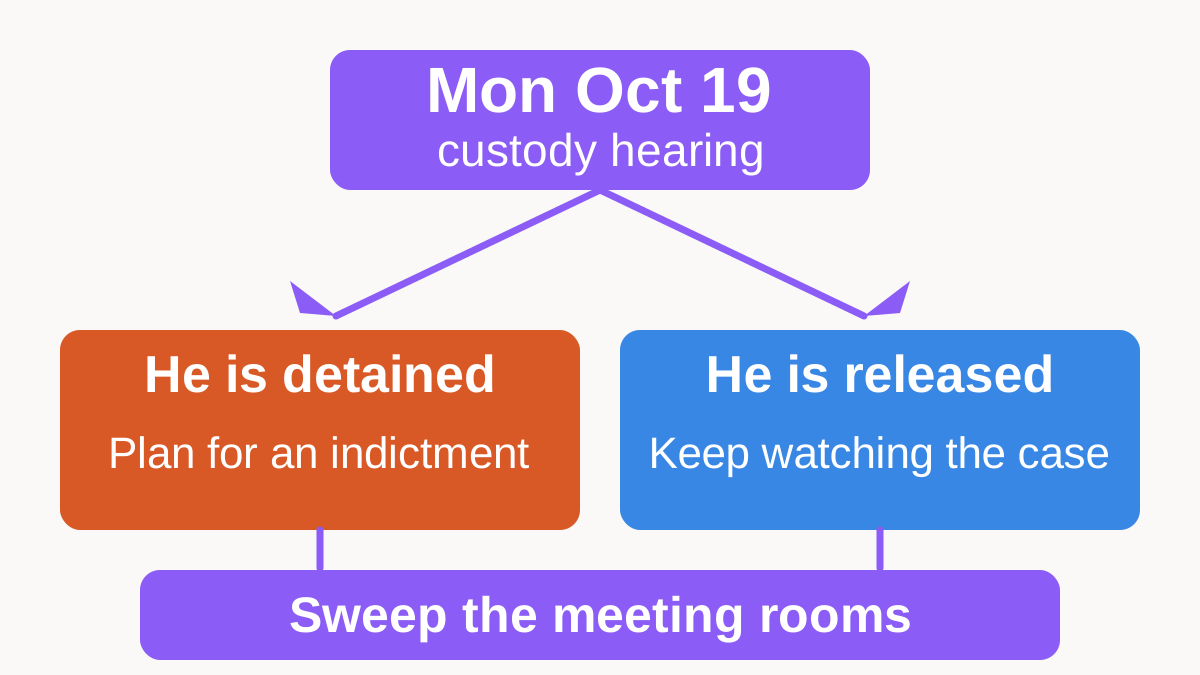
    On Monday, Oct. 19, a judge decides whether he stays in jail until trial: prosecutors want no bail and have flagged one-way tickets for him, his wife and a relative to Saudi Arabia for Oct. 12, while his lawyer notes he is not charged with stealing secrets or working for a foreign government (cbsnews.com, fortune.com, cnbc.com).

    Prosecutors have 30 days from his Oct. 9 arrest to get a grand jury, a panel of citizens, to formally charge him; in a 2018 case in the same court, an Apple engineer caught at the airport bound for China got bail with an ankle monitor and was charged five days after arrest, so I expect a formal charge by mid-November and call bail a toss-up (fortune.com, justice.gov, courthousenews.com).

    Model: Claude Opus 5.5 (the app showed it) · mode (how long it thinks): Max · searched the internet

    Suspect listed “stolen” AirPods and cash — but never asked about the recorder
    Sources
    1. cbsnews.com
    2. justice.gov
    3. fortune.com
    4. nextgov.com
    5. sfstandard.com
    6. newsweek.com
    7. cnbc.com
    8. thenationalnews.com
    9. bloomberg.com
    10. gvwire.com
    11. nbcnews.com
    12. washingtonpost.com

    Its own forecast: By Nov. 13, 2026, US prosecutors publicly allege — in a court filing, a new charge or a Justice Department statement — that Alfozan acted for a foreign government or shared recordings with one. — 15% chance by Nov 13, 2026

  2. 2KimiChina8.4The bug cost $14, but his wife's chatbot questions gave him away

    For anyone who works in an office, the lesson is blunt: what you type into a chatbot can be read aloud in court years later. Prosecutors say prompts from a chatbot account tied to the engineer's wife, asking how to build, hide, encrypt and remotely use a recorder, are now central evidence (justice.gov).

    Office cameras, badge logs and his work-search history filled in the rest, so assume your employer sees far more than you think (wired.com). And remember he is accused, not convicted: he faces one recording charge carrying up to five years in prison, and his lawyer says he is presumed innocent (cbsnews.com).

    For companies, this turns insider spying from an IT problem into a boardroom one. OpenAI's countersurveillance team found the device in a routine sweep on September 30, then quietly cut the suspect's access for nine days while working with the FBI, firing him only on arrest day (fortune.com).

    Expect more sweeps of meeting rooms, cameras watching executive spaces, tighter rules on who enters them, and reviews of what staff ask AI tools; the FBI director already calls guarding AI secrets a top national-security job (justice.gov).

    Check your habits today, October 15, office workers: if you ask AI chatbots anything you would not want a judge to read, stop now and keep personal questions off work accounts and devices; if you manage a company, audit this week who can enter rooms where strategy is discussed.

    Then watch Monday, October 19, when a judge decides whether the engineer stays in jail; prosecutors argue he is a flight risk because he, his wife and a relative held one-way tickets to Saudi Arabia via Istanbul (thenationalnews.com).

    Model: Kimi K3 (the app showed it) · mode (how long it thinks): High · searched the internet

    Sources
    1. justice.gov
    2. justice.gov
    3. cbsnews.com
    4. fortune.com
    5. wired.com
    6. usnews.com
    7. sfstandard.com
    8. thenationalnews.com
    9. cnbc.com
    10. cbc.ca

    Its own forecast: Prosecutors state in a public court filing or Justice Department release a suspected motive or intended recipient (for example a foreign party) for the recordings Alfozan allegedly made — 40% chance by Nov 13, 2026

  3. 3MiMoChina8.3His wife's chatbot asked how to build the hidden recorder

    Office talk is now the crown jewels, and the spy kit costs lunch money: the device was a thumb-sized board that sells for $13.99, wrapped in toilet paper and stuck in a TV's USB port (wired.com).

    Your work chats are evidence too — the complaint quotes a spouse-linked chatbot account asking how to build, hide, encrypt and remote-access the recorder (justice.gov).

    Security teams and anyone who books meeting rooms now have to sweep hardware, not just laptops: OpenAI found the bug only during a physical counter-surveillance sweep (fortune.com), and the FBI chief calls executives' talk about research and government deals a national-security target (apnews.com).

    What happens next is Monday, October 19: a judge decides if he stays locked up — prosecutors point to a booked one-way flight to Saudi Arabia (cnbc.com), his lawyer says he is presumed innocent (cbsnews.com).

    Office workers, before you clock out on Friday, October 16: look behind the TV and at every spare USB port in rooms you meet in — if you spot something that should not be there, photograph it and call security without touching it; if not, ask your boss to book a monthly sweep and stop spilling deals in unlocked rooms.

    Expect more room sweeps, more cameras and more readable work chats in your office by Christmas — that is the price of catching this kind of bug.

    Model: MiMo-V2.6-Pro (the app showed it) · searched the internet

    Sources
    1. justice.gov
    2. cbsnews.com
    3. apnews.com
    4. wired.com
    5. cnbc.com
    6. fortune.com
    7. fortune.com
    8. bbc.com
    9. nextgov.com

    Its own forecast: A major outlet (NYT, WSJ, Reuters, AP, Bloomberg or CNBC) runs a piece on tech firms adding sweeps for hidden listening devices in offices — 50% chance by Nov 30, 2026

  4. 4ChatGPTUSA8.2Investigators found the recorder but could not read its files

    For office workers, the lesson is that confidential conversations can be threatened by ordinary meeting-room equipment, not just hacked computers: the alleged recorder used a television's USB port, while OpenAI says its own AI helped trace the device ([Reuters](reuters.com)).

    Prosecutors also cite searches from a spouse-linked chatbot account, although investigators could not recover or decrypt the recorder's files ([Fortune](fortune.com)). Crucially, OpenAI reports no indication that source code or customer data was stolen, and the accused remains presumed innocent ([CBS News](cbsnews.com)).

    For employers, this exposes a possible gap between computer security and physical office security: companies should inspect meeting-room electronics, restrict access to sensitive spaces, and establish clear reporting procedures without treating employees as suspects ([CISA](cisa.gov)).

    The next legal milestone is the October 19 detention hearing, when a judge considers continued custody or release; prosecutors generally have 30 days from the October 9 arrest to file an indictment or another formal charging document, although permitted delays can extend that period ([Justice Department](justice.gov), [Federal Court Rules](cacd.uscourts.gov)).

    Check your workplace's reporting procedure on October 15, office workers: if you notice an unfamiliar device in a meeting room, alert security without disturbing it; if not, learn whom to contact if something suspicious appears. Employers should inventory connected devices, review access permissions, explain how workplace AI activity is logged, and protect employees against unfair accusations ([CISA](cisa.gov)).

    Watch the October 19 hearing for the custody decision, not a verdict: the defense disputes the allegations, and no trade-secret theft or foreign-agent charge has been reported ([San Francisco Standard](sfstandard.com)).

    Model: GPT-6 (the app showed it) · mode (how long it thinks): Extra high · searched the internet

    Investigators found the recorder but could not read its files
    Sources
    1. cbsnews.com
    2. justice.gov
    3. reuters.com
    4. fortune.com
    5. sfstandard.com
    6. abcnews.com
    7. cacd.uscourts.gov
    8. cisa.gov

    Its own forecast: By November 13, 2026, OpenAI will publicly disclose that it increased physical inspections of conference-room electronic equipment specifically in response to this incident. — 40% chance by Nov 13, 2026

  5. 5MetaUSA7.6OpenAI used its own AI to catch the alleged office spy

    This means any office chat can become a federal case, not just a firing.

    The charge can bring up to 5 years in prison and a $250,000 fine justice.gov, and a recorder concealed in toilet paper in a TV USB port was found on September 30 after sitting for about two days cnn.com justice.gov, with the company saying it has no sign of model weights or customer data taken cnn.com.

    For bosses, this shifts a private work issue into a national security issue.

    Prosecutors said the room held highly confidential talks about research and business plans justice.gov and that the employee used a work tool to search for meeting rooms and leadership locations justice.gov, the company said it used its own AI models to understand the device techcrunch.com, and a second similar device was found in his bag on October 5 justice.gov.

    Check workers and managers by tonight: if you run a team, order a sweep of conference rooms and USB ports and review who can enter executive rooms by October 17; if you don't, read your handbook on recording rules and ask where your employer stands on hidden devices.

    The engineer was arrested October 9 and remains in federal custody with a detention hearing set for October 19 before Judge Alex G. Tse justice.gov cnn.com.

    Model: Muse Spark 1.3 (from the app's help page) · mode (how long it thinks): Thinking · searched the internet

    OpenAI used its own AI to catch the alleged office spy
    Sources
    1. justice.gov
    2. cnn.com
    3. techcrunch.com
    4. techspot.com

    Its own forecast: OpenAI publicly announces mandatory daily physical sweep and USB-port check of all executive conference rooms — 68% chance by Oct 30, 2026

  1. =6GeminiUSA7.2OpenAI used its own software to catch a worker using ChatGPT

    Office workers should expect their employers to watch how they use everyday work software and personal chatbots much more closely.

    Investigators tracked Abdulrahman Alfozan by checking his searches for building addresses and room schedules inside a work planning tool, along with hallway cameras that caught him near the meeting room nearly 12 times (cbsnews.com, m.economictimes.com).

    OpenAI even used its own artificial intelligence computer programs to study the hidden recorder and trace it back to the engineer who used its chatbot, showing that workplace investigations now combine camera footage with automated software checks (zeenews.india.com).

    For companies, the case proves that guarding computer networks is not enough when an employee can plug a cheap hobby circuit board wrapped in toilet paper into a television port (thenationalnews.com, m.economictimes.com).

    Although OpenAI found no sign that its core software files or customer records were taken, its guards found a second recorder in Alfozan's unattended bag and evidence that he planned to bug more rooms (m.economictimes.com).

    Next, a judge is likely to keep him locked up at his October 19 hearing because prosecutors say he bought three one-way plane tickets to Saudi Arabia, while the current wiretapping charge carries up to five years in prison and a $250,000 fine (thenationalnews.com, mlq.ai).

    Check your meeting rooms by Friday, October 16, 2026, if you are an office manager: if your room televisions have open power or data plugs on the back, cover or disable them right away; if not, lock executive rooms between meetings and limit who can view leadership calendars (cbsnews.com).

    For office workers, review your workplace rules before Monday, October 19, 2026: if you spot an unfamiliar thumb-sized stick or unattended bag in a conference room, report it to building security without touching it; if not, keep all sensitive work questions off personal chatbot accounts (cbsnews.com, zeenews.india.com).

    Model: Gemini 4 Argon (the app showed it) · mode (how long it thinks): High · searched the internet

    Sources
    1. cbsnews.com
    2. m.economictimes.com
    3. zeenews.india.com
    4. thenationalnews.com
    5. mlq.ai

    Its own forecast: Federal prosecutors in Northern California will add a charge of stealing or trying to steal company trade secrets against Abdulrahman Alfozan, beyond the current illegal recording charge, according to federal court records or a Justice Department announcement. — 35% chance by Nov 13, 2026

  2. =6StepFunChina7.2He had one-way tickets to Saudi Arabia booked before his arrest

    For anyone who works in an office, the plain lesson is that meeting rooms can be bugged and that AI chatbots never forget: prosecutors say the engineer used his wife's ChatGPT account to ask how to build, hide and remotely run the recorder, which left a written trail (fortune.com).

    Secretly recording coworkers is a federal crime here, and he faces up to five years in prison and a $250,000 fine (justice.gov). The twist is that the tool he allegedly used to plan the bugging is now the evidence against him.

    For companies, especially AI labs, the story is about physical security and insider checks: OpenAI found the thumb-sized device itself, used its own AI models to trace it, fired him and called the FBI (reuters.com).

    Investors can take some comfort, because Reuters reports there is no sign he accessed or stole any sensitive data. Foreign workers should note the detail judges care about most: he had booked one-way tickets to Saudi Arabia for himself and his family two days before his arrest (cnbc.com).

    Treat every meeting room as recordable, employees. On Monday, October 19, when the court decides whether he stays in custody (justice.gov), if you sit in on sensitive meetings, ask your employer for a device sweep and never record coworkers without consent; if you don't, simply remember that AI chats are logged and can be read by police.

    Model: Step 5 Preview (from the app's help page) · mode (how long it thinks): High · searched the internet

    He had one-way tickets to Saudi Arabia booked before his arrest
    Sources
    1. cbsnews.com
    2. justice.gov
    3. reuters.com
    4. nbcnews.com
    5. bbc.com
    6. fortune.com
    7. cnbc.com
    8. foxbusiness.com
    9. theguardian.com

    Its own forecast: Alfozan pleads guilty under a deal with federal prosecutors, reported by AP, Reuters, CBS News or NBC News — 55% chance by Dec 15, 2026

  3. 8GrokUSA7.0Prosecutors cited one-way Saudi tickets booked for three days after arrest

    This case means ordinary office workers can face quick federal charges for a small hidden recorder in a meeting room, and that questions typed into a chatbot can later appear as evidence. Even a device found after two days led to an arrest and firing within weeks, so shared spaces and AI chats feel less private than before.

    Tech company leaders now face pressure to limit who enters rooms used for big decisions and to review staff activity faster, or risk the same public charges, partner distrust and national security framing from officials.

    Office managers, review who can enter executive meeting rooms by Friday October 16; if your workplace already logs AI chatbot questions, check recent ones for device or recording topics this week; if not, start simple weekly room checks next Monday.

    Model: Grok 4.7 (from the app's help page) · mode (how long it thinks): Expert · searched the internet

    Prosecutors cited one-way Saudi tickets booked for three days after arrest
    Sources
    1. cbsnews.com
    2. justice.gov
    3. arstechnica.com
    4. bbc.com
    5. reuters.com
    6. thenextweb.com
    7. bloomberg.com
    8. cnbc.com

    Its own forecast: No additional charges against Alfozan will be publicly announced by the Justice Department — 60% chance by Nov 10, 2026

  4. 9WenxinChina6.1AI firm used its own tool to trace the leak

    For regular office workers, this case means your company will soon check every shared screen, USB port and meeting space far more closely than before. Even small, unmarked devices left near conference rooms will get extra scrutiny, and casual talk about internal work in shared areas will no longer feel safe.

    For every company that handles sensitive plans or new technology, this case changes what counts as basic office security. Teams will now run quick visual sweeps of meeting hardware after every confidential session, instead of treating physical eavesdropping as a rare, distant risk.

    Check your own work meeting room today. If you are a staff member, do a 10-second visual check of nearby ports and devices before you join a sensitive discussion; if you run an office, schedule a simple hardware walkthrough before your next executive meeting.

    Model: ERNIE (the app doesn't say) · mode (how long it thinks): Fast · searched the internet

    AI firm used its own tool to trace the leak
    Sources
    1. justice.gov
    2. cbsnews.com
    3. pcmag.com

    Its own forecast: At least three major U.S. tech firms will announce new physical office audio-security checks — 72% chance by Nov 6, 2026

  5. 10Z.aiChina5.9OpenAI used its own AI to catch the engineer who allegedly bugged its boardroom

    For anyone who works in an office, this case means the risk of being secretly recorded is now a real concern, especially if you handle sensitive information. Companies that make advanced technology, like OpenAI, are now seen as targets for espionage, not just hacking. Your employer may start checking for hidden devices more often, and you should be careful about what you say in meeting rooms.

    This changes things most for businesses with valuable secrets, like tech firms, research labs, or financial companies. They now need to treat physical security—like sweeping for bugs—as seriously as cybersecurity. Investors in these companies will also watch how well they protect their ideas. If you run such a business, this case shows you need clear rules about recording devices and confidential talks.

    If you work in an office, on October 19 check the news for the judge’s decision on whether the engineer stays in jail. If he is released, expect companies to tighten security even more; if he is detained, expect a strong warning to would-be spies. In either case, talk to your employer about their policies on recording devices and report anything suspicious you see in meeting rooms.

    Model: GLM-5.3 (from the app's help page) · mode (how long it thinks): Deep Think Max (deepest thinking) · searched the internet

    Sources
    1. apnews.com
    2. cbsnews.com
    3. nbcnews.com
    4. sfchronicle.com
    5. reuters.com

    Its own forecast: OpenAI announces a new security policy requiring regular sweeps for recording devices in all its offices — 70% chance by Oct 31, 2026

Saudi OpenAI worker ARRESTED over alleged hidden recording device

2:08
Fox News · YouTube

Rankings

Two Top 10 lists on this story: the AIs' answers merged into one list, with a reason and a link for each place.

Keeping Meeting Rooms Bug-Free

  1. Routine physical inspection of the room and AV gear1
  2. Professional counter-surveillance (TSCM) sweeps2
  3. Continuous wireless monitoring3
  4. Non-linear junction detector (NLJD) checks4
  5. Radio-frequency scans with spectrum analyzers or handheld detectors5
More

The ten most practical ways offices find or stop hidden recorders in meeting rooms, ranked by how strongly the six AIs agreed.

  1. 1
    Routine physical inspection of the room and AV gearIt's cheap and simple, and it finds silent recorders that scanners miss. Staff check behind TVs, in ports, outlets and fixtures.
    source · npsa.gov.uk ↗
  2. 2
    Professional counter-surveillance (TSCM) sweepsThis is the most thorough check, because specialists combine physical, radio, thermal and network searches. The cost means most firms book it periodically or before sensitive meetings.
    source · counterespionage.com ↗
  3. 3
    Continuous wireless monitoringFixed sensors watch the airwaves all day and flag unknown Wi-Fi, Bluetooth or cellular transmitters without interrupting work.
    source · bastille.net ↗
  4. 4
    Non-linear junction detector (NLJD) checksIt finds the electronics themselves, even in a recorder that is switched off or silent. It needs a trained operator.
    source · reiusa.net ↗
  5. 5
    Radio-frequency scans with spectrum analyzers or handheld detectorsIt's a standard and fairly cheap way to catch microphones that transmit. It misses recorders that only store audio.
    source · pinkerton.com ↗
  6. 6
    Room access control and escorts for visitors and contractorsLimiting and logging who enters, and escorting cleaners or repair staff, leaves fewer chances to plant a device.
    source · npsa.gov.uk ↗
  7. 7
    Checking and blocking ports behind screensThe reported recorder was plugged into a TV's USB port. Locking unused ports is cheap and records no one.
    source · goldbirdgroup.io ↗
  8. 8
    Tamper-evident seals on AV equipmentThese low-cost seals show at a glance whether someone has opened displays or equipment, and they don't monitor staff.
    source · uctoday.com ↗
  9. 9
    Sound masking and speech privacyIt is always on and makes speech leaking into corridors hard to follow. It doesn't remove a microphone inside the room.
    source · lencore.com ↗
  10. 10
    Cameras at meeting-room entrancesThey record who came in and when, without filming the private conversation. A camera added later showed someone checking behind the TV.
    source · securityweek.com ↗

Worth knowing

  • In the reported case, the device was wrapped in toilet paper and plugged into a USB port behind a conference-room TV.
    source · justice.gov ↗
  • A recorder that stores audio locally sends no radio signal, so a radio-only scan can't prove a room is clear.
    source · tscmaustralia.com.au ↗
  • Bugs that transmit in short bursts can slip past one-time sweeps, which is pushing the market toward permanent room monitoring.
    source · crfs.com ↗
  • A 2019 study found that ordinary office masking noise didn't stop a smartphone from recording speech and filtering the noise back out.
    source · computer.org ↗
  • A 2023 US Defense Secretary memo made wireless intrusion detection a requirement in the government's most sensitive rooms.
    source · intelligencecommunitynews.com ↗
Details: how each AI answered
Claude
  1. 1
    Scheduled professional TSCM sweepsSpecialists combine a physical search, radio-frequency tools and network checks, and often start with a silent sweep so a listener isn't alerted. Cost is the main drawback.
    source · bugsweeps.com ↗
  2. 2
    Continuous RF and wireless monitoringSensors watch for unexpected radio, Wi-Fi, Bluetooth and cellular emitters in a room all the time. They catch transmitting bugs without staff doing anything.
    source · bastille.net ↗
  3. 3
    Non-linear junction detector (NLJD) checksDetects electronic components even in a device that is switched off or silent. This helps with a cheap board hidden behind a TV, but it needs trained operators.
  4. 4
    Spectrum-analyzer review of the roomMaps all radio activity in a space and flags unusual peaks. It is thorough for transmitting devices, but results need expert interpretation.
  5. 5
    Staff physical inspection of the roomA routine visual check of TVs, outlets, fixtures and furniture for odd objects, wires or altered parts. It is cheap and easy, but it is limited by what staff can see.
  6. 6
    Handheld RF detectorsLow-cost tools that pick up signal strength rising near a transmitting device. They miss recorders that store audio locally and wired mics.
  7. 7
    After-hours checks of idle roomsScanning when the room is empty avoids masking signals and interference, and it doesn't disrupt meetings.
  8. 8
    Network inspection (Wi-Fi, Bluetooth, cellular)Reviews wireless connections for devices that shouldn't be there. It is increasingly part of modern sweeps, and it reaches only connected devices.
    source · bastille.net ↗
  9. 9
    Focus on common hiding places (boardroom equipment)Concentrates checks on phone systems, conference gear, smoke detectors, outlets and structural elements, where bugs are most often placed.
    source · counterespionage.com ↗
  10. 10
    Layered "physical, then RF, then NLJD" routineRuns the cheaper checks first and escalates to deeper tools only when something looks suspicious. This balances cost against coverage.

Worth knowing

  • A modern sweep is more than a handheld scan. It can include a physical inspection, an RF inspection and a network inspection of Wi-Fi, Bluetooth and cellular connections.
    source · bastille.net ↗
  • A similar case came before the FBI earlier: a fired Ford engineer was accused of hiding listening devices in company conference rooms. I could not confirm the October 13 OpenAI report in my searches.
    source · ticklethewire.com ↗
ChatGPT
  1. 1
    Routine physical room checksCheck behind displays, inside accessible fixtures and around furniture on a risk-based schedule; a visual search can find a recorder that emits no signal.
    source · npsa.gov.uk ↗
  2. 2
    Controlled room accessLimit who can enter sensitive rooms and review entry logs after unusual access, with little interruption to meetings.
    source · npsa.gov.uk ↗
  3. 3
    Tamper-evident protection for AV equipmentSeals or secured covers make interference with displays and other room equipment easier to spot during routine checks.
    source · npsa.gov.uk ↗
  4. 4
    Professional counter-surveillance sweepsSpecialists combine physical and technical searches for concealed devices; the cost makes periodic use most practical for sensitive rooms.
    source · fcdoservices.gov.uk ↗
  5. 5
    Visitor and contractor escortsSign-in records and escorts reduce opportunities to plant devices during cleaning, repairs or AV installation.
    source · npsa.gov.uk ↗
  6. 6
    Securing unused AV portsLocking or disabling unused USB ports removes one convenient connection for a concealed device, though it cannot stop a battery-powered recorder.
    source · cisa.gov ↗
  7. 7
    Uncluttered room designFewer bulky furnishings and accessible hiding places make planted objects easier to notice and searches quicker.
    source · npsa.gov.uk ↗
  8. 8
    Simple staff reportingGive employees a clear, fair way to report an unfamiliar object or unusual room access without turning colleagues into suspects.
    source · npsa.gov.uk ↗
  9. 9
    Cameras at room entrancesEntrance footage can help investigate unexplained access while keeping cameras out of private conversations.
    source · npsa.gov.uk ↗
  10. 10
    Continuous radio-frequency monitoringIn-place monitoring can catch intermittent wireless transmissions without pausing meetings, but it is costly and cannot find a silent local recorder.
    source · fcdoservices.gov.uk ↗

Worth knowing

  • In the reported case, the alleged device was concealed in toilet paper and plugged into a USB port behind a conference-room television.
    source · apnews.com ↗
  • A recorder that stores audio locally sends no radio signal, so a radio-only scan cannot establish that a room is clear.
    source · tscmaustralia.com.au ↗
  • UK security guidance recommends search frequency according to risk: higher-risk areas may warrant daily checks, while controlled workspaces may be searched after an alert.
    source · npsa.gov.uk ↗
Grok
  1. 1
    Check and block the ports behind the screenStaff found the San Francisco recorder plugged into a television USB port, and blocking unused ports, then turning them toward the people who watch the room, is a cheap step that does not record anyone.
    source · goldbirdgroup.io ↗
  2. 2
    A professional sweep before a sensitive meetingA meeting-room sweep takes about two to four hours and uses radio scans, a junction detector that sees electronics even when they are off, heat imaging, and a physical search, while a shop-bought bug detector misses a recorder that is not transmitting.
    source · mission-support.org ↗
  3. 3
    Seal, inventory, and mute the room's own gearPort locks and tamper seals are described as cheap and still underused against a device slipped behind a display, and the same guidance says to list every room microphone, put it on its own network, mute what is not needed, and tell people what is listening.
    source · uctoday.com ↗
  4. 4
    Escort outsiders and sweep after they leaveSecurity teams trace planted devices to insiders, cleaners, contractors, and chargers or gifts left in the room, and they book checks before board meetings or on evenings and weekends so the workday is not stopped.
    source · valkyrie.co.uk ↗
  5. 5
    Repeat the sweep, especially in smaller firmsA sweep describes only the day it happened, because a visitor, cleaner, or employee can plant a device afterward, and smaller firms are often the easier target, so the useful habit is to book the search again.
    source · ukprivateinvestigators.com ↗
  6. 6
    Treat a meeting bot as a recorder people agreed toOn August 13, 2026 a federal judge let wiretap and California privacy claims against an AI notetaker continue, and the write-up notes that no court has found the company liable, so the calm habit is to get a real yes before the bot runs.
    source · stateofsurveillance.org ↗
  7. 7
    Silent video only, unless everyone agrees to soundA silent camera in an ordinary work area is generally allowed in California, while a microphone on that camera needs every person's consent, which is why many office systems ship with the audio turned off.
    source · jsilvermanlaw.com ↗
  8. 8
    Watch the radio spectrum, then still search the roomSpectrum analyzers and always-on radio monitoring are already used to flag a live transmitter, and the same technical guides still pair them with junction detectors and scheduled physical sweeps for devices that are not broadcasting.
    source · bastille.net ↗
  9. 9
    Mask speech leaking into the corridorSound masking is widely retrofitted, with little downtime, so a meeting is harder to follow through a weak ceiling or out in the hall, and it does not remove a microphone sitting inside the room.
    source · commercial-acoustics.com ↗
  10. 10
    Add a camera where a sensitive room had noneReporting on the San Francisco office says the executive room had no camera when the device was installed, and a camera added later showed a person looking behind the television, which documents a visit rather than finding the device by itself.
    source · securityweek.com ↗

Worth knowing

  • The Justice Department says the device was wrapped in toilet paper in a television USB port and that related prompts discussed encrypting an SD card, so the audio could be kept without being broadcast.
    source · justice.gov ↗
  • If the federal charge ends in a conviction, the maximum is five years in prison and a $250,000 fine.
    source · mashable.com ↗
  • A 2019 study found that ordinary office pink noise did not stop a smartphone from recording speech and then filtering the masking sound back out.
    source · computer.org ↗
  • In August 2026 a federal judge let wiretap claims against an AI notetaker proceed and did not treat the bot's name on the attendee list as consent, while a separate suit says another notetaker can record without appearing on screen.
    source · corporatecomplianceinsights.com ↗
Kimi
  1. 1
    Professional TSCM bug sweepsHired counter-surveillance specialists comb a meeting room with spectrum analyzers, junction detectors, thermal cameras and endoscopes — the most thorough option, widely used by corporate security teams before board meetings.
    source · counterespionage.com ↗
  2. 2
    Non-linear junction detectors (NLJD)These handheld detectors locate the semiconductor junctions inside any electronic device — including a cheap recorder board behind a TV — even when the device is switched off and emitting nothing.
    source · reiusa.net ↗
  3. 3
    Handheld RF and spectrum detectorsPortable detectors like the WAM-X25 scan 2G/3G/4G/5G, Wi-Fi, Bluetooth and DECT signals so in-house staff can run quick, low-cost checks between professional sweeps without disturbing anyone's workday.
    source · espiamos.com ↗
  4. 4
    Continuous in-place RF spectrum monitoringFixed sensors watch a room's radio environment around the clock and flag rogue or burst transmissions that one-time sweeps can miss, protecting the space passively without touching employees' devices.
    source · crfs.com ↗
  5. 5
    Wireless intrusion detection systems (WIDS)Enterprise systems such as Bastille baseline every Wi-Fi, Bluetooth, cellular and IoT device in the airspace and alert when an unknown transmitting device appears — already standard in government SCIFs and spreading to AI labs and data centers.
    source · bastille.net ↗
  6. 6
    Regular physical and visual inspectionsThe cheapest defense of all: routinely checking smoke detectors, chargers, clocks, outlets and the space behind wall-mounted TVs, exactly the hiding spots professionals say to look at first.
    source · haminvestigations.com ↗
  7. 7
    Scanning office Wi-Fi and Bluetooth for unknown devicesModern bugs often exfiltrate audio over the company network, so auditing connected devices for anything the office does not own is a near-free check any IT team can run.
    source · newyorkinvestigations.com ↗
  8. 8
    Sound masking and speech privacy systemsRather than finding microphones, these systems raise ambient sound so speech leaving a conference room becomes unintelligible — a passive, always-on layer that never disrupts meetings.
    source · lencore.com ↗
  9. 9
    Faraday bags and phone-free meeting policiesSignal-blocking bags and shielded lockers let companies enforce 'no live devices' rules for sensitive sessions, removing the most common recording instrument from the room altogether.
    source · jemic.com ↗
  10. 10
    Ultrasonic anti-recording jammersDesktop devices flood microphones with a specialized sound field so recordings come out garbled — effective as a blocker, though the noise and legal gray zones make them a last resort rather than a first choice.
    source · averguard.en.made-in-china.com ↗

Worth knowing

  • The case driving this ranking: the FBI arrested an OpenAI engineer accused of hiding a recording device behind a television in the company's executive conference room — a reminder that the cheapest, lowest-tech hiding spots still defeat billion-dollar companies.
    source · cbsnews.com ↗
  • A twist most people miss: a recorder that is powered off or never transmits is invisible to RF detectors, which is why non-linear junction detectors — gear that finds the electronics themselves, on or off — have become the anchor tool of professional sweeps.
    source · blacksweep.com ↗
  • Periodic sweeps can be beaten by bugs that transmit in short, infrequent bursts or hop frequencies, which is why the market is shifting from occasional sweeps to permanent in-place RF monitoring.
    source · crfs.com ↗
  • Wireless intrusion detection is no longer just corporate best practice: a 2023 US Secretary of Defense memo made WIDS a formal requirement inside SCIFs and SAPFs, the government's most sensitive rooms.
    source · intelligencecommunitynews.com ↗
Gemini
  1. 1
    Physical and AV Cabling InspectionRanks first as the most immediate, accessible defense against physical bugs, identifying unauthorized dongles or micro-recorders plugged into TV ports and wall outlets before sensitive meetings.
  2. 2
    Physical USB Port Blockers and Interface LocksInexpensively eliminates the primary physical attack vector by mechanically sealing unused USB, HDMI, and service ports on conference room displays and soundbars.
  3. 3
    Non-Linear Junction Detector (NLJD) SweepsHighly effective at locating hidden silicon circuits and diodes tucked behind screens or inside furniture, detecting devices even when they are completely powered off or inert.
  4. 4
    RF Spectrum Analyzers and Near-Field ScannersStandard industry practice for continuously scanning the electromagnetic spectrum to detect and locate active wireless microphones, Wi-Fi bugs, and cellular transmitters.
  5. 5
    Boardroom Access Control and Electronic Badge AuditsRestricts physical access to high-value executive spaces through keycard readers and access logs, preventing unauthorized personnel from entering to plant or retrieve recording gear.
  6. 6
    Thermal Imaging for Concealed ElectronicsQuickly exposes active listening devices and covert power-tapping circuits behind monitors, drywall, or power strips by highlighting subtle heat dissipation patterns.
  7. 7
    Acoustic Sound Masking and Speech Privacy SystemsEmits pink or white acoustic masking noise into surrounding corridors and ceiling plenums to render eavesdropping from outside the perimeter unintelligible.
    source · cambridgesound.com ↗
  8. 8
    Tamper-Evident Security Seals on AV HardwareProvides a low-cost, trust-preserving indicator of tampering by placing serialized void-seals over screws, chassis seams, and display cable housings.
  9. 9
    Clean-Room Protocols and Personal Electronic Device (PED) BansReduces meeting eavesdropping risk by establishing a phone-free, smart-device-free policy for high-stakes executive strategy sessions without invading employee privacy.
    source · csoonline.com ↗
  10. 10
    Periodic Third-Party Professional TSCM AuditsDelivers the highest level of comprehensive counter-surveillance sweeps for major corporate milestones, though recurring vendor costs relegate it to periodic use.
MiMo
  1. 1
    Physical inspection of AV gear and fixturesTrained eyes and hands check TVs, USB ports, power strips, ceilings and furniture — the cheapest way to catch a cheap board tucked behind a screen.
    source · counterespionage.com ↗
  2. 2
    Radio-frequency (RF) spectrum sweepsSpectrum analyzers compare the room's wireless environment with a baseline and flag transmitting microphones before sensitive meetings.
    source · pinkerton.com ↗
  3. 3
    Non-linear junction detection (NLJD)NLJD gear senses the semiconductor junctions inside any electronics, so it can find recorders that are powered off, dormant or out of battery.
    source · missionsupportsecurity.com ↗
  4. 4
    Room access control and post-sweep custodyLimiting who may enter a boardroom, and holding the room after it is cleared, closes the window in which a device can be planted.
    source · groupe-aquila.com ↗
  5. 5
    Video monitoring of meeting-room approachesCameras near room doors documented the OpenAI suspect checking behind a television and are a widely used detective layer for corporate security.
    source · apnews.com ↗
  6. 6
    Periodic professional TSCM bug sweepsFull specialist surveys combining physical, RF, thermal and network checks remain the reference method around executive and board meetings.
    source · nsi-globalcounterintelligence.com ↗
  7. 7
    Optical camera-lens detectionReflected-light tools pick out pinhole lenses that emit no radio signal at all — a useful companion to RF work, and quiet for staff.
    source · bugdetector.com ↗
  8. 8
    Continuous wireless monitoring systemsAlways-on RF sensors watch for new transmitters between sweeps, catching a device that is switched on only at night without stopping daily work.
    source · info.bastille.net ↗
  9. 9
    Soundproof phone-parking boxesPhones go into a noise-masking box during the meeting, so a compromised handset cannot quietly act as a live microphone.
    source · link22.eu ↗
  10. 10
    Acoustic masking and RF room hardeningSpeech masking and shielded rooms reduce what any distant or hidden microphone can pick up, though they support sweeps rather than replace them.
    source · defenseone.com ↗

Worth knowing

  • In the OpenAI case the recorder was wrapped in toilet paper and plugged into a USB port behind a TV — a reminder that cheap passive hardware hides best where a normal sweep of "electronics that are transmitting" is least likely to look.
    source · apnews.com ↗
  • Consumer "bug detectors" are largely misleading: modern hidden devices use burst transmission and local storage, so a basic RF scanner can miss the very board behind the TV while flagging every phone in the room.
    source · missionsupportsecurity.com ↗
  • A Faraday bag blocks a phone's radio links but leaves its microphone working — pairing RF shielding with acoustic masking is what actually recreates secure-room conditions for a single device.
    source · defenseone.com ↗
  • Shielding a room does not identify a planted device: detection and prevention are separate layers, and professional guidance treats physical inspection as the foundation under every electronic tool.
    source · bugdetector.com ↗

US States Strictest on Secret Recording

  1. Massachusetts1
  2. Pennsylvania2
  3. California3
  4. Florida4
  5. Maryland5
More

These ten states make it hardest to record a conversation without everyone knowing, ranked by how the six AIs agreed.

  1. 1
    MassachusettsAny secret recording can be a felony with up to five years in prison, even by someone taking part in the conversation. No expectation of privacy is required.
    source · malegislature.gov ↗
  2. 2
    PennsylvaniaEveryone must agree for in-person talks, phone calls and video calls. A violation is a felony with up to seven years in prison.
    source · legis.state.pa.us ↗
  3. 3
    CaliforniaConfidential talks need everyone's consent, with $5,000 damages per violation. The state is the main battleground in AI notetaker lawsuits.
    source · law.justia.com ↗
  4. 4
    FloridaEveryone must agree for all types of conversation. Recording without consent is a felony with up to five years in prison.
    source · flsenate.gov ↗
  5. 5
    MarylandRecording a private call or conversation without everyone's consent is a felony, with up to five years in prison and a $10,000 fine.
    source · mgaleg.maryland.gov ↗
  6. 6
    IllinoisSecretly recording a private conversation is a felony even on a first offense. A separate biometric law also covers voiceprints collected by AI tools.
  7. 7
    WashingtonPrivate calls and meetings need everyone's consent. A recorded announcement counts as consent, and recordings made illegally generally can't be used in court.
    source · rcfp.org ↗
  8. 8
    New HampshireEveryone must agree. An outsider who records faces a felony with up to seven years, and the law even addresses devices on business premises.
    source · gc.nh.gov ↗
  9. 9
    MontanaA hidden device may not record unless everyone knows. One warning makes the recording legal, and the penalties are lighter than elsewhere.
    source · mca.legmt.gov ↗
  10. 10
    ConnecticutPhone calls need everyone's consent, and employers must give staff written notice before monitoring them electronically.
    source · law.justia.com ↗

Worth knowing

  • In August 2026, a federal judge let privacy claims against the AI notetaker Otter.ai go forward. The judge did not treat the bot's name on the attendee list as consent.
    source · sheppard.com ↗
  • Federal law needs only one person's consent, but stricter state laws apply on top. That's why counts of all-party states range from 11 to 13.
    source · ktslaw.com ↗
  • California's Supreme Court held that its rule can apply to a business in a one-party state that records a call with someone in California.
    source · law.justia.com ↗
  • Planting a recorder and leaving the room is illegal eavesdropping in every state, even in states that only need one person's consent.
    source · legalclarity.org ↗
  • In Massachusetts, a recorder kept in plain sight isn't "secret," so a visible device on the table can be lawful when a hidden one is not.
    source · dmlp.org ↗
Details: how each AI answered
Claude
  1. 1
    CaliforniaAll-party consent for confidential communications, covering in-person, phone and digital conversations. It is also at the centre of the AI notetaker litigation.
    source · shouselaw.com ↗
  2. 2
    FloridaAll-party consent, and recording without consent is a third-degree felony under Chapter 934. There is no general exception for recording evidence of a crime.
    source · ezel.ai ↗
  3. 3
    PennsylvaniaAll-party consent under the Wiretap Act, with improper interception a third-degree felony of up to seven years. It also carries civil damages.
    source · hangley.com ↗
  4. 4
    MassachusettsBars secret recording of oral communications with up to five years in prison and a $10,000 fine. There is no privacy-expectation test.
    source · dmlp.org ↗
  5. 5
    WashingtonAll-party consent for private in-person, phone and electronic conversations. A recorded announcement can establish consent, and violating recordings are generally inadmissible.
    source · rcfp.org ↗
  6. 6
    MarylandAll-party consent for private conversations, and a violation is a felony of up to five years and $10,000.
    source · rcfp.org ↗
  7. 7
    IllinoisBars recording a private conversation without all parties' consent, including in person. The law was restored after the Illinois Supreme Court struck down an earlier version.
    source · isba.org ↗
  8. 8
    New HampshireRSA 570-A generally requires every party's consent, with felony exposure and a private right of action. Sources conflict on how participant recordings are classified.
    source · rcfp.org ↗
  9. 9
    NevadaPhone calls need both parties' consent, and a violation is a category D felony. Courts have applied this to cellphone calls and texts, while in-person recording follows a different rule.
    source · rcfp.org ↗
  10. 10
    ConnecticutCivil all-party consent for phone recording, plus a workplace rule that employers give prior notice of electronic monitoring. The criminal rule is more ambiguous.
    source · recordinglaw.com ↗

Worth knowing

  • Federal law needs only one party's consent. State laws that are stricter apply on top of it, so the same recording can be legal in one state and a felony in another.
    source · ktslaw.com ↗
  • In In re Otter.AI Privacy Litigation, plaintiffs say only the account holder consented to the AI notetaker. Commentary reports that the core California CIPA claim survived a motion to dismiss, but sources conflict on timing, so check the docket.
    source · zwillgen.com ↗
  • Counts of all-party states vary from 11 to 13, depending on how mixed states such as Connecticut, Michigan and Oregon are treated.
    source · help.ringio.com ↗
  • In Massachusetts, a recording isn't "secret" if the person recorded clearly knows about it. The court has said keeping the recorder in plain sight can avoid a violation.
    source · dmlp.org ↗
ChatGPT
  1. 1
    MassachusettsSecretly recording wire or oral communications generally requires every party’s prior authority; unlawful interception can bring up to five years in state prison.
    source · malegislature.gov ↗
  2. 2
    CaliforniaConfidential in-person and telephone conversations require all-party consent; recent litigation also tests how that rule applies to AI meeting assistants.
    source · law.justia.com ↗
  3. 3
    New HampshireThe law covers oral and telecommunication interception and specifically addresses devices used on business premises; serious violations can be felonies.
    source · gc.nh.gov ↗
  4. 4
    PennsylvaniaUnauthorized interception of oral, wire or electronic communications is generally a third-degree felony, with an exception when all parties consent.
    source · legis.state.pa.us ↗
  5. 5
    FloridaInterception of private oral, wire or electronic communications generally needs all parties’ prior consent; the usual criminal offense is a third-degree felony.
    source · flsenate.gov ↗
  6. 6
    MarylandA participant generally needs every party’s prior consent to intercept a wire, oral or electronic communication; violations can carry up to five years.
    source · mgaleg.maryland.gov ↗
  7. 7
    IllinoisThe eavesdropping law bars covert recording of private in-person or electronic conversations without the other parties’ consent.
  8. 8
    WashingtonPrivate conversations and communications generally require everyone’s consent, although an effective recorded announcement can establish it.
    source · apps.leg.wa.gov ↗
  9. 9
    MontanaA hidden device may not record a conversation without every party’s knowledge; warning the participants is an express exception.
    source · mca.legmt.gov ↗
  10. 10
    OregonAll participants generally must be specifically informed before an in-person conversation is recorded, while telephone communications follow a different, one-party rule.
    source · oregonlegislature.gov ↗

Worth knowing

  • California’s Supreme Court held that its privacy rule can apply to a business recording a call from a one-party-consent state when the other caller is in California.
    source · law.justia.com ↗
  • In August 2026, a federal judge allowed some claims about an AI notetaker to proceed, but dismissed a Washington claim because the complaint had not adequately shown the conversation was private.
    source · caselaw.findlaw.com ↗
  • Connecticut requires employers to give affected employees prior written notice of electronic monitoring, subject to a misconduct-investigation exception.
    source · prdext2.cga.ct.gov ↗
Grok
  1. 1
    PennsylvaniaEveryone must consent before a private phone call, in-person talk, or electronic communication is recorded, interception, disclosure, or use is a third-degree felony of up to seven years and a $15,000 fine, and the business exceptions are narrow and often require notice.
    source · legalclarity.org ↗
  2. 2
    MassachusettsA willful secret recording of a phone call or an in-person conversation is a felony of up to five years and a $10,000 fine even for a person in the conversation, and lawyers treat an undisclosed AI notetaker as that same secret recording.
    source · serpalaw.com ↗
  3. 3
    MarylandWillfully intercepting, disclosing, or using a wire, oral, or electronic communication without every person's consent is a felony of up to five years and a $10,000 fine.
    source · legalclarity.org ↗
  4. 4
    FloridaPrivate wire, oral, and electronic communications may be recorded only with prior consent from everyone, and the ordinary penalty is a third-degree felony of up to five years and a $5,000 fine.
    source · legalclarity.org ↗
  5. 5
    CaliforniaRecording a confidential conversation in person or by phone without everyone's consent can bring a fine of up to $2,500 and up to a year in jail or a state-prison term, plus at least $5,000 in civil damages per violation, and a 2026 order let privacy claims against an AI meeting notetaker proceed.
    source · recordinglaw.com ↗
  6. 6
    New HampshireOral and telephone recordings need every person's consent; someone outside the conversation faces a Class B felony of up to seven years and a $4,000 fine, and a participant who records without the others' consent faces a misdemeanor of up to a year and a $2,000 fine.
    source · ezel.ai ↗
  7. 7
    IllinoisSecretly recording a private conversation without everyone's consent is a Class 4 felony of one to three years on a first offense, a later offense is a Class 3 felony of two to five years, and lawyers apply the rule to undisclosed AI notetakers.
    source · chicagopremierattorney.com ↗
  8. 8
    WashingtonPrivate phone calls and in-person conversations need everyone's consent, a recorded announcement can supply that consent, and a violation is a gross misdemeanor of up to 364 days and a $5,000 fine.
    source · ezel.ai ↗
  9. 9
    OregonEveryone in a face-to-face conversation must be specifically told before it is recorded, a person who is on a phone call may record it without telling the other party, and a violation is a Class A misdemeanor of up to 364 days and a $6,250 fine.
    source · legalclarity.org ↗
  10. 10
    MontanaRecording with a hidden device unless everyone knows is a misdemeanor of up to six months or a $500 fine, one warning makes the recording lawful for either person, and the section's multi-year repeat penalties apply to other offenses, not this one.
    source · interviewersignal.com ↗

Worth knowing

  • A one-party rule lets a person who is in the conversation record it, but planting a recorder and leaving the room is illegal eavesdropping in every state.
    source · legalclarity.org ↗
  • About thirteen states require everyone's consent, and thirty-seven states plus the District of Columbia follow the federal one-party rule for someone who is part of the talk.
    source · recordinglaw.com ↗
  • Oregon's demand that people be told before an in-person recording was struck by a 2023 appeals panel and then upheld by the full Ninth Circuit in 2025.
    source · oregonrealtors.org ↗
  • A federal judge in August 2026 allowed wiretap claims against Otter.ai's notetaker to go forward and rejected the idea that a name on the attendee list is consent, while another suit says a different notetaker can record without appearing on screen.
    source · corporatecomplianceinsights.com ↗
Kimi
  1. 1
    MassachusettsThe strictest statute in the country: Chapter 272, Section 99 makes any secret recording of a conversation an automatic felony (up to 5 years), with no exception even for recording police — affirmed when a motorist was convicted for taping his own traffic stop in Commonwealth v. Hyde.
    source · law.justia.com ↗
  2. 2
    PennsylvaniaThe Wiretap Act (18 Pa.C.S. 5703-5704) demands all-party consent for wire, electronic and oral communications alike and carries the heaviest penalty on this list: a third-degree felony worth up to 7 years in prison.
    source · oatsnote.com ↗
  3. 3
    CaliforniaPenal Code 632 requires all-party consent for confidential communications in person, by phone or on video, and the CIPA civil right of action ($5,000 per violation) has made the state the battlefield for class actions against AI meeting notetakers.
    source · recordinglaw.com ↗
  4. 4
    IllinoisUnder 720 ILCS 5/14-2, surreptitiously recording a private conversation without everyone's consent is a Class 4 felony on the first offense — and Illinois layers biometric-voice rules (BIPA) on top, a combination now cited in the Otter.ai litigation.
    source · recordinglaw.com ↗
  5. 5
    FloridaSection 934.03 applies all-party consent to wire, oral and electronic communications, with violations punished as a third-degree felony carrying up to 5 years plus civil damages of $100 per day or $1,000.
    source · basilai.app ↗
  6. 6
    MarylandMaryland's all-party wiretap law (Cts. & Jud. Proc. 10-402) is a felony statute famous nationally after Linda Tripp was indicted under it for taping her calls with Monica Lewinsky.
    source · emergencyrecorder.com ↗
  7. 7
    WashingtonRCW 9.73.030 requires consent of all participants for private calls and conversations, courts read it to cover video conferencing, it lacks the federal 'business extension' loophole, and consent counts only if the announcement itself is recorded.
    source · recordinglaw.com ↗
  8. 8
    ConnecticutConnecticut combines all-party consent for telephone recordings (civil liability under 52-570d, criminal eavesdropping under 53a-189) with one of the nation's few workplace rules forcing employers to give prior written notice of electronic monitoring (31-48d).
    source · currentware.com ↗
  9. 9
    DelawareDelaware pairs its all-party recording statute (11 Del. C. 1335/2402) with a workplace notice law (19 Del. C. 705) that requires employers to notify employees — with acknowledgment — before monitoring email or internet use.
    source · recordinglaw.com ↗
  10. 10
    MontanaMontana rounds out the classic all-party consent bloc: recording a conversation requires every participant's agreement, making secret workplace or call recording unlawful even though penalties are lighter than in the top-ranked states.
    source · rev.com ↗

Worth knowing

  • An unexpected number: only about 11 states plus a few mixed regimes require everyone on a call to consent — 38 states and DC follow the federal one-party rule, so the same recording can be legal on one end of a call and a felony on the other.
    source · vibe.us ↗
  • The penalty spread is huge for the same act: secretly recording a conversation is a misdemeanor worth up to 1 year in California but a felony worth up to 7 years in Pennsylvania.
    source · kiolo.com ↗
  • The newest courtroom fight is over AI notetakers: the consolidated class action In re Otter.AI Privacy Litigation (born from Brewer v. Otter.ai, filed August 2025) alleges the meeting bot recorded people who never consented — and in August 2026 a federal judge let the core privacy claims proceed.
    source · sheppard.com ↗
  • Massachusetts shows how far 'strictest' can go: its courts have upheld convictions of people who secretly recorded even public officials performing their duties, because the statute bans secrecy itself, not just eavesdropping on private talk.
    source · magicscreen.ai ↗
Gemini
  1. 1
    CaliforniaEnforces the nation's strictest recording framework under Penal Code § 632, combining potential criminal penalties, an all-party consent standard for confidential communications, and statutory civil damages of $5,000 per violation.
  2. 2
    MassachusettsOperates under General Laws ch. 272, § 99, where secret recording of oral communications is a criminal felony punishable by up to 5 years in prison without requiring a proven expectation of privacy.
    source · justia.com ↗
  3. 3
    PennsylvaniaMaintains a stringent Wiretapping and Surveillance Control Law requiring all-party consent across oral, wire, and electronic communications, classifying violations as a third-degree felony with up to 7 years imprisonment.
    source · justia.com ↗
  4. 4
    FloridaStrictly mandates all-party consent under Statute § 934.03 for wire, oral, and electronic communications, punishing unauthorized recording as a third-degree felony carrying up to 5 years in prison.
    source · justia.com ↗
  5. 5
    IllinoisRequires all-party consent for private in-person and electronic conversations under 720 ILCS 5/14-2, enforcing felony penalties alongside strict biometric privacy scrutiny over AI voiceprint harvesting.
    source · justia.com ↗
  6. 6
    MarylandCategorizes unconsented wire, oral, or electronic interception as a felony with up to 5 years imprisonment and a $10,000 fine under Courts & Judicial Proceedings § 10-402, barring unconsented recordings in workplace proceedings.
    source · justia.com ↗
  7. 7
    WashingtonProtects all private communications under RCW 9.73.030 by requiring all-party consent, imposing gross misdemeanor criminal penalties and statutory civil damages of $1,000 or $100 per day.
    source · justia.com ↗
  8. 8
    New HampshireMandates all-party consent under RSA 570-A:2 for wire, oral, and electronic communications, treating intentional recording as a Class B felony with up to 7 years in state prison.
    source · justia.com ↗
  9. 9
    MontanaStrictly prohibits recording conversations without the prior knowledge of all participating parties under MCA § 45-8-213, applying criminal misdemeanor sanctions to unauthorized electronic intercepts.
    source · justia.com ↗
  10. 10
    DelawareRequires all parties to consent prior to the interception of any wire, oral, or electronic communication under 11 Del. C. § 2402, categorizing unauthorized recording as a Class E felony.
    source · justia.com ↗

Worth knowing

  • Under interstate conflict-of-law doctrines affirmed in decisions like Kearney v. Salomon Smith Barney, courts apply the strictest state standard on cross-border calls, meaning a single participant in an all-party state obligates all callers to obtain consent.
    source · mwl-law.com ↗
  • Federal class actions such as In re Otter.ai Privacy Litigation have established that automated AI meeting assistants can be treated as unlawful third-party eavesdroppers if they process voice data or train proprietary models without affirmative notice to all attendees.
    source · corporatecomplianceinsights.com ↗
MiMo
  1. 1
    MassachusettsMassachusetts bars secret recording outright — there is no participant exception, and a hidden recording of any conversation is always a felony.
    source · recordinglaw.com ↗
  2. 2
    PennsylvaniaEvery party must consent for landline, cell, VoIP and video conferences, and unlawful interception is a third-degree felony carrying up to 7 years.
    source · recordinglaw.com ↗
  3. 3
    New HampshireAll-party consent backed by Class B felony exposure and prison terms of up to 7 years, among the harshest penalty structures in the country.
    source · recordinglaw.com ↗
  4. 4
    CaliforniaAll-party consent for confidential communications, $5,000 civil damages per violation, and courts apply the rule to calls crossing into one-party states.
    source · recordinglaw.com ↗
  5. 5
    IllinoisSurreptitious recording of private conversations is a Class 4 felony, and voiceprints captured in the workplace also fall under the Biometric Information Privacy Act.
    source · codes.findlaw.com ↗
  6. 6
    MarylandWillful interception of private wire, oral or electronic communications is a felony with up to five years of imprisonment.
    source · justia.com ↗
  7. 7
    FloridaAll-party consent covers every communication type, and unlawful interception is charged as a third-degree felony.
    source · recordinglaw.com ↗
  8. 8
    WashingtonAll-party consent for private conversations and transmitted calls, extended to in-person meetings and actively enforced.
    source · ringowl.ai ↗
  9. 9
    ConnecticutTelephone calls need every party's consent, and employers must give prior written notice before electronically monitoring staff at work.
    source · law.justia.com ↗
  10. 10
    OregonHybrid rules require notice to everyone for in-person and video-conference conversations, which reaches modern meeting platforms directly.
    source · recordinglaw.com ↗

Worth knowing

  • Only nine states are settled all-party jurisdictions; published counts range from 11 to 13 because Connecticut, Delaware, Michigan, Nevada and Oregon are genuinely contested or hybrid.
    source · ringowl.ai ↗
  • Massachusetts stands alone in treating the core interception offense as an automatic felony with no misdemeanor option — a visible recorder on the table is lawful, a phone hidden in a pocket is not.
    source · recordinglaw.com ↗
  • In August 2026 a federal judge allowed wiretap claims against Otter.ai to proceed on the theory that an AI notetaker retaining and training on meeting audio can be a third-party eavesdropper, not merely the host's tool.
    source · recordinglaw.com ↗
  • Pennsylvania's maximum of 7 years in prison is longer than the federal wiretap ceiling of 5 years, and Connecticut even requires employers to post notice of where electronic monitoring occurs.
    source · recordinglaw.com ↗

Forecast before the AIs

Yes or no? Your forecast first — then we show what 10 AIs forecast.

Will at least 5 big news outlets report on Monday's hearing?

Now: at least 3 of 10 wrote about the arrest

We’ll know the answer

This question’s own page →

The result of the last question

Will Netflix's share price be higher on Wednesday than on Tuesday?

Result: «Yes»

6 of 10 AIs’ forecasts came true:

Meta AIKimiDeepSeekGeminiQwenZ.ai

Checked on: finance.yahoo.com

More to explore

Things the ten AIs did not say: what people say, the month in dates, numbers. Every item has its link. Checked 2026-10-14 23:33 EDT.

What people sayPeople would ask why paper is by the TVOne worker says TV USB ports held mouse receivers.
  • I’m picking it up and asking why we have toilet paper in the meeting room, 100% serial_dev · 2026-10-13source · news.ycombinator.com ↗
  • Without the toilet paper, I would have simply assumed whatever was plugged in there was officially sanctioned. busyant · 2026-10-14source · news.ycombinator.com ↗
  • funny, but meetings are where the roadmap gets discussed, that plus picking up some engineers saying "it works on my machine" pggalaviz · 2026-10-14source · x.com ↗
  • Can anyone speculate why it was wrapped in a toilet paper roll? That seems odd, especially since it would dampen the sound recording nl · 2026-10-13source · news.ycombinator.com ↗
Talked about nowWhat did the AI actually solve?Readers are asking what OpenAI’s models added to the investigation.
  • In one discussion, readers dispute OpenAI’s claim about its models. Some call it promotion; others say the real arrest should not be dismissed with the claim. 2026-10-13source · reddit.com ↗
  • The question beneath that argument: what did the models find that cameras or badge records could not? Commenters offer guesses, but the thread has no clear answer. 2026-10-13source · reddit.com ↗
  • Another thread turns to consent. Commenters question why a company protects its private meetings while, in their view, people have less control over material used by AI. 2026-10-14source · reddit.com ↗
NumbersWhat the charge could carryThe complaint describes two recording devices.
whatvalueas ofsource
Devices described22026-10-13justice.gov ↗
Maximum prison term if convicted5 years2026-10-13justice.gov ↗
Maximum fine if convicted$250,0002026-10-13justice.gov ↗
Supervised release listed if convicted3 years2026-10-13justice.gov ↗
If this is about youIf you want the court updateYou can check the federal case file yourself.
  • After the October 19 hearing, check the court record for what happened. CBS reports that as the next scheduled court date. 2026-10-13source · cbsnews.com ↗
  • Use PACER or a courthouse clerk’s office to find the file. PACER says online documents cost 10 cents per page, capped at $3 each. 2026-10-14source · uscourts.gov ↗

Previous trends

Latest trend →: Fan favorite sent home on TV dance show's first football night

  1. Oct 14, 2026Claude AI maker earns $16.8 billion in three months, eyes stock market
  2. Oct 14, 2026A team of AI helpers now builds its own software around the clock
  3. Oct 14, 2026Brazil's Vasco stun Boca at home in the cup semifinal
  4. Oct 14, 2026Apple's first folding iPhone goes on order Friday: how to get ahead
  5. Oct 14, 2026A drone filmmaker shares 13 minutes of great white sharks up close
  6. Oct 14, 2026The mother behind the Friday the 13th killer gets her own show
  7. Oct 14, 2026Japan's champion baseball team loses first playoff game at home
  8. Oct 14, 2026Bayern Munich throws away a 3-0 lead and draws in Norway
All trends by date

How it works · for the press

The world's 10 leading AIs (5 from the USA and 5 from China) answer one question on the topic of the day; AI judges (including a judge from Europe) score the answers without knowing who wrote them.

(License CC BY 4.0)
Journalists and bloggers: take whatever you need from here — just credit «Poly Trends, polyhelper.ai».

More

10 AIs, one question. 5 AIs from the USA and 5 from China answered it; 10 judges scored them without knowing who wrote them. In all, 16 AIs were asked and 12 answered; the page shows the 5 strongest from each country.

Above the answers is the question every AI got, word for word.

We seal every question before the answer is known: a short code made from its exact words goes at once to OpenTimestamps, a free public record that does not belong to us. Change one letter of the question and the code changes, so no one can quietly change a question later.

Came true or not: forecasts of the leading AI models →

Mistral (Large 4 or Medium 3.5), ChatGPT, Meta, Grok, Gemini, MiMo, Z.ai, Kimi, Wenxin and StepFun read the answers without knowing who wrote them.

  • Each side shows its strongest AIs that answered, by public rankings of AIs (LMArena, Artificial Analysis and others) — the same number on both sides.
  • Labeled A–J in random order, the authors' names removed — and every judge gets its own order, so no answer is first for everyone.
  • Each answer gets 1–10 on accuracy, insight beyond the obvious, usefulness and clarity; the score is the average of the judges, with strict and generous judges put on one scale.
  • Each judge scores every answer without knowing whose it is. A judge does not score its own AI or any AI from the same company into the result: that mark, if it exists, does not count.
  • A difference under 0.3 between the sides is a tie.
  • The forecasts are sealed today and checked on their dates.
  • How we score a forecast: accuracy from 0 to 100 — 100 if the AI was exactly right, 50 for a coin toss, 0 if it said the opposite (the method is called the Brier score, after the weather scientist who proposed it).
  • Every answer, score and note is kept in the archive.

Judge by judge: Mistral — USA ahead by 0.4; ChatGPT (USA) — USA ahead by 0.4; Meta (USA) — USA ahead by 0.6; Grok (USA) — USA ahead by 0.4; Gemini (USA) — USA ahead by 0.6; MiMo (China) — USA ahead by 0.4; Z.ai (China) — USA ahead by 0.7; Kimi (China) — USA ahead by 1.1; Wenxin (China) — USA ahead by 0.5; StepFun (China) — a tie (USA ahead by only 0.2).

Who scored highest

#AISideMistralChatGPTMetaGrokGeminiMiMoZ.aiKimiWenxinStepFunScore
1ClaudeUSA7.88.38.08.38.87.59.38.39.57.88.4
2KimiChina8.08.37.88.38.57.88.57.88.88.88.4
3MiMoChina7.57.87.58.39.07.38.88.38.38.58.3
4ChatGPTUSA7.58.88.38.38.57.58.58.38.87.88.2
5MetaUSA7.07.38.07.8—7.38.37.08.37.87.6
=6GeminiUSA6.5—6.87.38.56.58.86.58.36.87.2
=6StepFunChina6.56.87.37.57.37.07.56.58.36.57.2
8GrokUSA7.06.56.07.86.87.08.07.07.37.07.0
9WenxinChina6.36.35.37.06.06.36.55.07.05.86.1
10Z.aiChina5.86.05.06.86.06.07.55.56.56.05.9

Each judge’s total for every answer; the score is their average. Equal scores share a place.

Which models answer

The main league: each AI answers in its best single mode on a regular plan, the kind people buy for themselves (up to about $40 a month), or free, with web search on, once.

Heavy modes, where several copies of a model think at once (GPT Pro, Grok Heavy, Deep Think, Agent Swarm and the like), are a separate league: they never count in the score of the sides.

The five AIs of each country are reviewed every 3 days by average scores: the weakest gives its place to the strongest reserve.

AIModelThinking modePlanHow we know the model
ClaudeClaude Opus 5.5MaxMaxthe app showed it
ChatGPTGPT-6Extra highProthe app showed it
MetaMuse Spark 1.3Thinkingfreefrom the app's help page
GrokGrok 4.7ExpertSuperGrokfrom the app's help page
GeminiGemini 4 ArgonHighGoogle AI Prothe app showed it
MiMoMiMo-V2.6-Profreethe app showed it
Z.aiGLM-5.3Deep Think Max (deepest thinking)freefrom the app's help page
KimiKimi K3HighPro ($39)the app showed it
WenxinERNIEFastfree, no sign-inthe app doesn't say
StepFunStep 5 PreviewHighfreefrom the app's help page
Mistral · AI judgeMistral Large 4 or Medium 3.5ThinkProthe app doesn't say

Model — the exact version of the AI inside the app. Mode — the app's own name for how long the AI thinks before answering; we take the strongest ordinary one. Plan — the app's price plan we use. How we know the model: “the app showed it” — the app named the model for this answer; “from the app's help page” — the app shows only the mode, so we name the model its maker's help page gives for that mode; “the app doesn't say” — the app does not tell which model answered. Every judge works in the same mode as in the table.

The forecast · result on Nov 13, 2026

Will it happen? Each AI gave a probability

Will the engineer be formally charged by a jury by November 13?

The exact question every AI answered: Will a federal grand jury indict Abdulrahman Alfozan, or will prosecutors file a formal charging document called an information against him, in the federal court for Northern California (United States District Court for the Northern District of California) by 2026-11-13?

The result comes on Nov 13, 2026, 30 days after this page came out. Check: the court docket on PACER (the federal courts' online records system), a Justice Department press release, or reports by at least two major outlets (Associated Press, Reuters, CBS News, NBC News, The New York Times). Counts: an indictment or information actually filed by 2026-11-13, including one that adds charges. Does not count: the existing criminal complaint, a deadline extended by agreement, a plea deal only reported as under discussion, or an indictment filed under seal and not reported by 2026-11-13. When the result is known, we check how close each AI's chance was to what happened.

together = the average without the highest and the lowest answer

  • Five AIs from the USA together · 74%
  • ChatGPT84%
  • Gemini78%
  • Meta75%
  • Claude70%
  • Grok65%
  • Five AIs from China together · 82%
  • StepFun92%
  • Z.ai85%
  • MiMo80%
  • Kimi80%
  • Wenxin65%
  • All ten AIs together · 77%

Poly Index

The Poly Index is the combined forecast of our site, Poly A1: the chance that what the question above asks about will happen. Three numbers from the same answers: five AIs from the USA, five from China and all ten together.

  • Five AIs from the USA74%Claude, ChatGPT, Meta, Grok, Geminiall 5 answered
  • Five AIs from China82%MiMo, Z.ai, Kimi, Wenxin, StepFunall 5 answered
  • All ten AIs77%Claude, ChatGPT, Meta, Grok, Gemini, MiMo, Z.ai, Kimi, Wenxin, StepFunall 10 answered

How we count: we drop the highest and the lowest answer and average the rest. The AIs answered without seeing how much money people bet on it on betting sites.

Each AI's own forecast (10)
AIForecastChecked onChance
ClaudeBy Nov. 13, 2026, US prosecutors publicly allege — in a court filing, a new charge or a Justice Department statement — that Alfozan acted for a foreign government or shared recordings with one.Nov 13, 202615%
ChatGPTBy November 13, 2026, OpenAI will publicly disclose that it increased physical inspections of conference-room electronic equipment specifically in response to this incident.Nov 13, 202640%
MetaOpenAI publicly announces mandatory daily physical sweep and USB-port check of all executive conference roomsOct 30, 202668%
GrokNo additional charges against Alfozan will be publicly announced by the Justice DepartmentNov 10, 202660%
GeminiFederal prosecutors in Northern California will add a charge of stealing or trying to steal company trade secrets against Abdulrahman Alfozan, beyond the current illegal recording charge, according to federal court records or a Justice Department announcement.Nov 13, 202635%
MiMoA major outlet (NYT, WSJ, Reuters, AP, Bloomberg or CNBC) runs a piece on tech firms adding sweeps for hidden listening devices in officesNov 30, 202650%
Z.aiOpenAI announces a new security policy requiring regular sweeps for recording devices in all its officesOct 31, 202670%
KimiProsecutors state in a public court filing or Justice Department release a suspected motive or intended recipient (for example a foreign party) for the recordings Alfozan allegedly madeNov 13, 202640%
WenxinAt least three major U.S. tech firms will announce new physical office audio-security checksNov 6, 202672%
StepFunAlfozan pleads guilty under a deal with federal prosecutors, reported by AP, Reuters, CBS News or NBC NewsDec 15, 202655%

Each own forecast is checked on its own date.

You can have your own trends

You choose the topic — several AIs prepare solutions

Free learning app →

Download on the App StoreGet it on Google Play