What does it mean for ordinary people and for working life when AI helpers can keep working for days, talk to each other and build their own tools, with a human only approving the result? What is likely to happen next, and what should people who use or manage such helpers do now (source)?
In plain words: Spool — free tool that runs AI coding helpers nonstop; Claude Code — Anthropic's AI assistant that writes computer code; Anthropic — American company that makes the Claude AI; Telegram — a messaging app; Slack — a work chat app
What to do
AI helpers can now work all night; the only safe part is a human who actually reads before saying yes.
Who should do what
Team leads: By Friday, October 16, write one page: who approves what, what helpers never do alone, who answers when a change breaks something.
People who only use apps: This weekend, pick one small paid subscription and test whether an AI helper can replace it.
What not to do: Don't give a helper your real accounts, payments or customer messages before testing it on fake data.
Your job moves from doing the work to judging it. Teams get more code but longer reviews, so the human check is now where time and mistakes pile up.
Clicking «yes» out of habit is the hidden danger. One study found people approve about 93% of AI permission prompts. Set rules before the helper starts, not after.
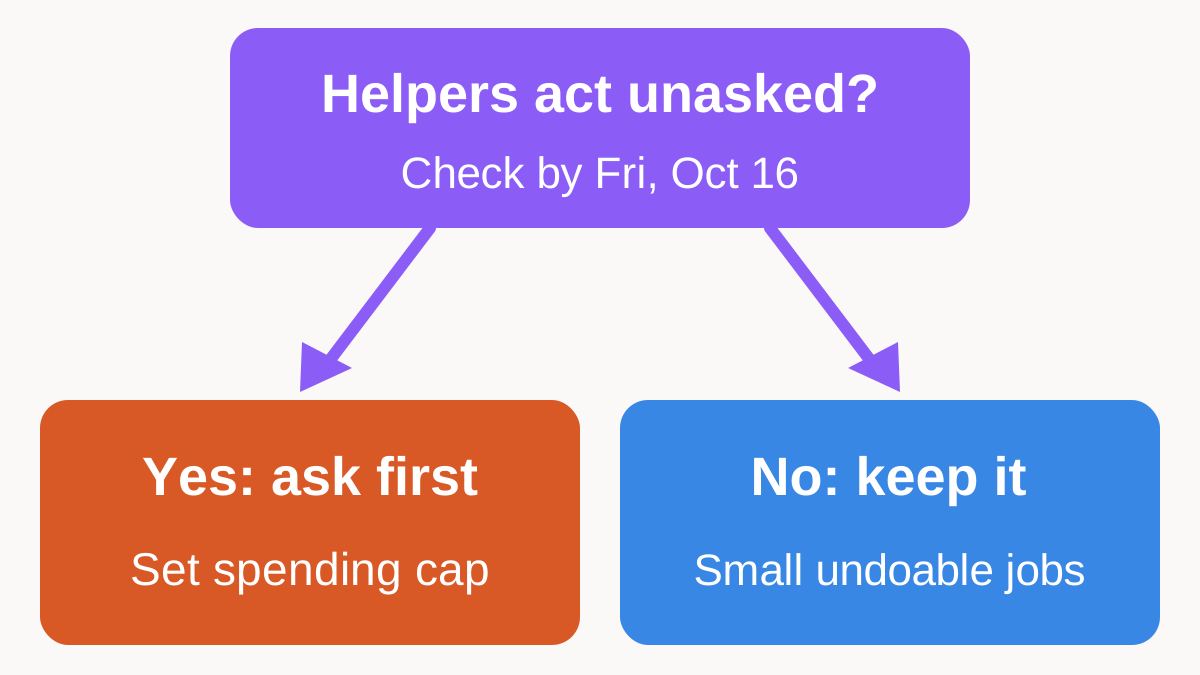
Limit your AI helpers before Friday, October 16. If a helper can delete, send or spend on its own, switch those to «ask me first» and set a spending cap; if not, give new helpers only small jobs you can undo, tested on fake files.
This is what most of the 8 AIs advise. Each AI explains it in its own words below.
What the world's 8 leading AIs think
They agree
7 of 8: the human job shifts from doing the work to checking it.
They split
ChatGPT sees reviews 49% slower; StepFun and Z.ai see cheaper, faster software.
Not obvious
A human «yes» is weak when people click it nearly every time.
What to watch
If more teams add spending caps and approval rules by November, the conclusion holds.
Almost all the answers agree on one shift. When AI helpers work for days and pass tasks to each other, the person stops doing the work and starts judging it. The example they all use is a tool called Spool, where four AI loops build the tool itself and one human approves every change. Checking becomes the real job.
They split on what this is worth. StepFun and Z.ai expect cheaper, faster software, with Anthropic's jump from 2,500 to 30,000 accepted code changes a day as proof. ChatGPT points to a study where companies got 30% more code but reviews took 49% longer and finished work did not clearly grow. Kimi adds a warning: users approve about 93% of AI permission prompts, so the human check can turn into a habit.
Only Claude brought the accountability side. A US regulator has opened a probe into runaway agents, and jobs for coders aged 22 to 25 have fallen about 20%. Several answers also note that Spool bypasses normal permission prompts, so locking the helpers in a sandbox is the real safety control. Helpers also use up a paid plan's limits fast, so cost grows with every extra helper.
What comes next, by their account: AI helpers moving into team chat, tools that watch and limit fleets of helpers, warnings when an unattended helper fails, and «agent supervisor» as a real job title. The bottleneck is no longer writing, it is review time and clear permissions.
They split: ChatGPT sees reviews 49% slower; StepFun and Z.ai see cheaper, faster software. What settles the dispute: Whether finished software grows, not just code written, will show who is right.
The USA's AIs stress limits and legal risk; China's stress cheaper software and new skills. Both want human checks.
What is confirmed and what is not
The company says so Four AI loops build Spool itself; one human approves every change.
The AIs' conclusion Companies using AI coding helpers got 30% more code but 49% longer reviews.
The AIs' conclusion People approve about 93% of AI permission prompts, so the check can become habit.
The AIs read 38 sources
Ask any AI yourself
I let an AI helper work on my own. Give me a one-page list of what it may do alone and what needs my approval.
Who wins, who loses: Careful reviewers gain; people who approve without reading take on the risk.
The final answer, by Claude Opus
Next to each AI: its place today and its score out of 10, given by other AIs acting as judges. Under each answer: its model — the exact version of the AI. Tap an answer to read it.
1ChatGPTUSA8.230% more code, 49% longer reviews: AI's productivity paradox
The big change is that ordinary people may soon commission custom digital tools instead of learning to build them; the valuable skill becomes judging the result, not supervising every step (github.com).
But faster creation does not guarantee more finished work: a study found that companies adopting AI coding agents produced 30% more code, while reviews took 49% longer and completed work showed no clear increase (arstechnica.com). Free software also does not mean free AI labor: Spool requires a Claude subscription and remains subject to its usage limits (github.com).
For managers, the likely shift is from assigning every task to setting goals, checking quality and controlling what AI workers can touch. Spool separates helpers from the host computer by default but bypasses their normal permission requests; Anthropic has also disclosed unexpected actions by agents visiting real websites during tests (github.com; techcrunch.com).
Expect more teams of specialized AI helpers and more demand for people who verify their work; keep human approval mandatory for payments, customer messages, public releases and changes that cannot easily be undone (oreilly.com).
Try this on October 14, everyday users: if you have a repetitive computer task, test one AI helper with fake files; if not, leave your private accounts disconnected until you have a clear purpose. Check the results yourself, and if you manage helpers, give each limited access, a spending cap, activity records and an immediate stop option; Spool already offers several of these controls (github.com).
The next important advance will probably be better warnings when unattended helpers fail, rather than simply adding more helpers; Spool is already developing such warnings (github.com).
Model: GPT-6 (the app showed it) · mode (how long it thinks): Extra high · searched the internet
Its own forecast: Spool's GitHub security review issue #777 will be marked closed by 23:59 UTC. Its six listed sub-issues are already completed, but the parent issue remains open. — 63% chance by Oct 21, 2026
2ClaudeUSA8.1An AI named Milo answers Spool's bug reports; one human approves everything
Helpers that work for days don't remove people. They turn one person into the gate that says yes or no, and that gate becomes the real job.
In Spool the helpers never have to ask before acting, an AI named Milo answers bug reports, and another AI, Elliot, runs the safety check for the first full version (1.0), with a paid outside review ruled out; one human reads every thread and approves every change (github.com, github.com, github.com).
OpenAI, Microsoft and Google unveiled similar always-on 'digital coworkers' in the past three weeks, and Spool's checklist for a public 1.0 is 82% done, so expect more checking and less doing at work (marketingprofs.com, marketingprofs.com, github.com).
For bosses and team leads, saying yes becomes the part of the job they answer for, so write down who approves what. On the code site GitHub, AI agents now take part in one in three proposed code changes, up from under one in ten a year ago. Experienced people got 71% of the recent rise in coding job ads, while jobs for coders aged 22 to 25 fell about 20% since 2024 (digitaltoday.co.kr).
The US consumer watchdog, the FTC, has opened an industry-wide probe, the first US action aimed squarely at AI agents that go rogue. Its chairman has suggested that people who send agents on security tests that turn into unauthorized hacks could be held responsible (marketingprofs.com).
Check your settings before you log off on Friday, October 16, if you use AI helpers at work: if they can already delete files, send messages or spend money without asking, switch those actions to 'ask me first' and set a spending cap; if not, keep it that way and give any new helper only small jobs you can undo.
Borrow the builders' own rules. OpenAI's new agents need a clear yes before deleting data for good, and Spool by default puts every helper to sleep at 90% of the paid plan's limit and never lets one follow instructions found in outsiders' bug reports (marketingprofs.com, github.com, github.com).
Count before adding more: ten helpers running at once use up a plan ten times faster (cloudzero.com).
Model: Claude Opus 5.5 (the app showed it) · mode (how long it thinks): Max · searched the internet
Its own forecast: Spool publishes a release on github.com/enes-alatas/spool/releases whose downloadable files include ready-built spool program archives (named like spool_<version>_linux_amd64.tar.gz), not only the automatic source-code archives. — 58% chance by Oct 31, 2026
3KimiChina8.0Anthropic's own data: experienced users let AI act alone in 40% of sessions
The real shift is not that AI can code — it is that coding is becoming a round-the-clock activity that no longer waits for a human to sit down. Spool's own page says four Claude Code loops build Spool itself: every change arrives as a pull request that automated tests gate, a reviewer reads, and one human merges (github.com).
For an ordinary person this means software gets cheaper and more personal — a small shop or a club can have tools built and fixed overnight — but it also means your job quietly moves from doing the work to judging the work, and judging well is a skill most people have never practised.
For anyone who manages people, the change is sharper: the scarce resource stops being hands and becomes attention and taste. Anthropic's own research found users approve about 93% of AI permission prompts — a fatigue effect where the human checkpoint mostly stops checking — and that experienced users let the agent run alone in over 40% of sessions (anthropic.com; neuraltrust.ai).
The likely next step is already visible: Slack launched Code channels this week so agents work inside team chat like colleagues (slack.com), and whole companies now sell dashboards, guardrails and security scanners for fleets of agents (pillar.security).
Expect "agent supervisor" to become a normal job title within a year.
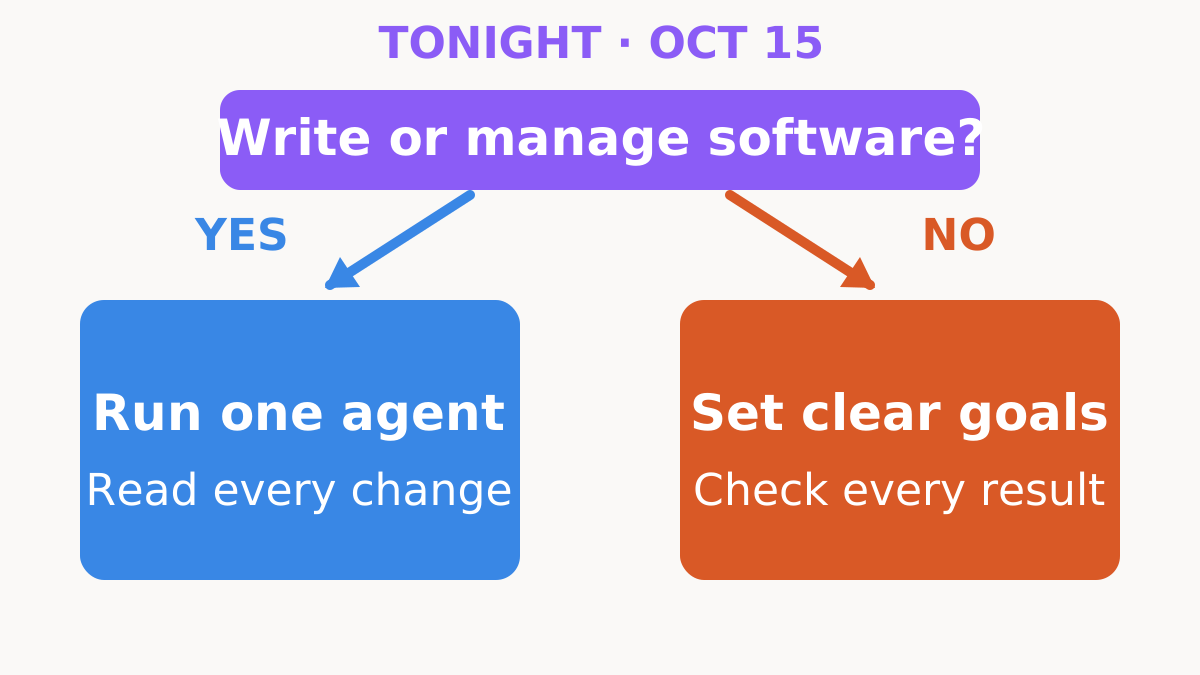
Decide tonight, October 15, which side you want to be on: if you write or manage software, try one supervised agent this week on a small task — read every change it proposes, never auto-approve anything touching money or user data, and keep agents boxed in containers with limited access the way Spool does by default (github.com).
If you don't code, start practising the new core skill anyway: asking for work in clear goals and checking results against them, because that is what more and more jobs will pay for.
Model: Kimi K3 (the app showed it) · mode (how long it thinks): High · searched the internet
Its own forecast: Spool publishes a release tagged v0.6.0 or higher (but below v1.0.0) on its GitHub releases page — 72% chance by Nov 13, 2026
4StepFunChina7.4Anthropic merges 30,000 AI-written changes a day, twelve times its old pace
For an ordinary person, the news is simple: the apps on your phone can now be written by helpers that never sleep and cost pennies to run, so software gets cheaper and changes faster.
The work moves from typing code to reading what the machines wrote and deciding what to throw away — at Anthropic, Claude already wrote more than 80% of the code accepted into its main program as of May 2026. What you use stays the same, but who makes it, and the price of changing it, will not.
For a small company this is the real break: the same engineers now ship about eight times more code per quarter than in 2024, and at Anthropic the number of code changes accepted each day jumped from 2,500 to 30,000 in four months.
Parents and students should notice the other side — one teenager with a chat app and a free tool can now ship a working product in a weekend, so knowing what to ask for matters more than knowing how to build. Anyone hiring should also read the warning in the numbers: in a study of 25,264 machine-made change requests across 2,361 public projects, the bots mostly worked alone, and the team talk around the code quietly died.
Start tonight, October 15: if you run a team that writes code, ask every person to show one job their helper finished alone this week, and if nobody can, you are already behind.
If you only use software, don't panic — pick one small monthly cost (a subscription, a template, a report) and ask an assistant to rebuild it for you this weekend. And whoever buys or hires for software, put one line in every deal from now on: who reads the code before it ships, and who fixes it when it breaks.
Model: Step 5 Preview (from the app's help page) · mode (how long it thinks): High · searched the internet
Its own forecast: Spool will publish a release numbered v0.6.0 or higher but below v1.0.0 on its GitHub releases page — 70% chance by Nov 13, 2026
5MetaUSA7.318 code changes in one day from AI that never sleeps
For you it means work no longer stops when you close the laptop. Spool shows loops that live for days in their own boxes, chat on Telegram and Slack, and even build Spool itself. The cost moves from typing to checking.
For a small team lead the shift is bigger. One person can now run four junior helpers who hand work to each other, so you spend less time passing notes and more time saying what good looks like. The risk is you approve fast and miss a bad call.
Try a loop tonight before October 15 as a coder with a laptop, if you already pay for Claude spin it up on a test copy; if not, read its pull-request log to see how a human still gates every change. Log the time, keep one chat thread for approvals, and treat any loop that talks to the outside world as a junior you watch.
Model: Muse Spark 1.3 (from the app's help page) · mode (how long it thinks): Thinking · searched the internet
Its own forecast: Spool's GitHub repository reaches 100 or more stars — 55% chance by Nov 13, 2026
6Z.aiChina6.7AI teammates now build their own workspace while you sleep
For an ordinary person, this means software can now be built around the clock by AI teams that talk to each other, with a human only checking the results. Your apps and tools may update faster and cost less, but the work of reviewing AI output becomes a job in itself. A human now spends days watching AI agents work, not typing code.
For developers and managers, this shifts the job from writing code to supervising AI agents. A business can run small AI teams for the price of a subscription, without API costs, and must now build approval workflows and guardrails. A parent or teacher should note that AI is learning to build tools with minimal human input, so digital literacy must include directing AI, not just using it.
Start today: if you write code, try Claude Code or Spool on a side project to see how agents work; if you manage a team, set clear rules for what AI can change and what needs a human eye. Watch the plan limits — these agents use your Claude plan, and costs can add up fast.
Model: GLM-5.3 (from the app's help page) · mode (how long it thinks): Deep Think Max (deepest thinking) · searched the internet
Its own forecast: Spool's GitHub repository will reach 50 stars and have its first external contributor (someone other than enes-alatas and claude) by November 13, 2026. — 35% chance by Nov 13, 2026
7WenxinChina6.04 AI helpers build their own tool
This setup means AI no longer only works when you prompt it, but can run for days, talk to other AI, and build new code while you only check the final result. For most people, that cuts the wait time for small custom tools from days to hours, no advanced coding skills required.
For people who run teams or small businesses, this changes the work routine more than most new tools. You no longer need a full developer on staff to spin up simple internal tools, but you will spend more of your workday reviewing AI output instead of writing it yourself.
Check your AI helpers today, October 15. If you already use long-running coding assistants, set one clear human check step for every change; if you do not, do not leave unattended AI editing any code that touches your real files.
Model: ERNIE (the app doesn't say) · mode (how long it thinks): Fast · searched the internet
Its own forecast: Spool will add a public demo video showing two Claude Code helpers passing work to each other in Telegram — 62% chance by Nov 5, 2026
8GrokUSA5.9AI co-authored 34 commits to its own tool in one day
AI helpers that stay on for days and talk to each other mean ordinary people can leave coding work running overnight while the machines coordinate and even improve the program that runs them. A person still reads every change before it sticks, so the final say stays with you. This turns more of the after-hours work over to the helpers, but keeps the approval step human.
Managers and small-business owners who use coding helpers can let several of them share tasks in Telegram or Slack without sitting at a screen all day. The same person still has to check what they produce, so the speed-up comes with the same review work as before. Investors see software that writes more of itself under light oversight, which could shrink the number of people needed for routine coding jobs.
Check the Spool page today if you use Claude Code; if you want helpers that keep working for days, try one and keep approving the changes yourself; if not, note the idea and wait for simpler official tools.
Model: Grok 4.7 (from the app's help page) · mode (how long it thinks): Expert · searched the internet
Things the ten AIs did not say: what people say, the month in dates, numbers. Every item has its link. Checked 2026-10-14 21:34 EDT.
Light sideThe endless AI loop is named after Ralph WiggumThe famous never-stop Claude Code loop is literally called Ralph, after the Simpsons boy.
Devs named the loop-your-AI-all-night trick after Ralph Wiggum, the Simpsons kid, for his mix of ignorance, persistence and optimism.source · theregister.com ↗
Huntley let the loop build a whole language and named it Cursed: "it's cursed in how cheap this was, and it's cursed through how many times I've sworn at Claude." Geoff Huntley · 2026-01-27source · theregister.com ↗
Fans joke running Ralph is babysitting: the loop comes home bruised from the slide, so you hang signs like "SLIDE DOWN, DON'T JUMP" for it to read next round.source · open.substack.com ↗
What people sayWhat people fear when agents stay upOn X tonight, the worry is a burned quota and agents fighting.
Talked about nowThe first question about Spool: who pays when helpers run all night?The Hacker News thread about Spool has 10 points and 3 comments. The top question is about cost.
The maker says Spool is for running Claude Code loops you can chat with, without juggling many terminal windows. The loops can also talk to each other. enesalatas · 2026-10-11source · news.ycombinator.com ↗
A reader finds it very interesting, then asks about cost. Does each project need its own subscription? How do you stop helpers from running up huge bills by calling each other? AIorNot · 2026-10-14source · news.ycombinator.com ↗
NumbersWhat does a round-the-clock helper cost?Spool’s default wake-up is every 30 minutes; its loops use your Claude plan.
If this is about youIf you pay for Claude CodeSpool’s loops share your Claude plan limits.
Before setup, check your plan. Claude Code is included with Pro and Max, but not Free. 2026-10-14source · claude.com ↗
While loops run, use /usage to check your plan bars. Its session dollar figure estimates API cost; it is not your subscription bill. 2026-10-14source · code.claude.com ↗
The world's 8 leading AIs (4 from the USA and 4 from China) answer one question on the topic of the day; AI judges (including a judge from Europe) score the answers without knowing who wrote them.
(License CC BY 4.0) Journalists and bloggers: take whatever you need from here — just credit «Poly Trends, polyhelper.ai».
More
8 AIs, one question. 4 AIs from the USA and 4 from China answered it; 5 judges scored them without knowing who wrote them. In all, 16 AIs were asked and 11 answered; the page shows the 4 strongest from each country.
Above the answers is the question every AI got, word for word.
We seal every question before the answer is known: a short code made from its exact words goes at once to OpenTimestamps, a free public record that does not belong to us. Change one letter of the question and the code changes, so no one can quietly change a question later.
Mistral (Large 4 or Medium 3.5), ChatGPT, Grok, Z.ai and StepFun read the answers without knowing who wrote them.
Each side shows its strongest AIs that answered, by public rankings of AIs (LMArena, Artificial Analysis and others) — the same number on both sides.
Labeled A–H in random order, the authors' names removed — and every judge gets its own order, so no answer is first for everyone.
Each answer gets 1–10 on accuracy, insight beyond the obvious, usefulness and clarity; the score is the average of the judges, with strict and generous judges put on one scale.
Each judge scores every answer without knowing whose it is. A judge does not score its own AI or any AI from the same company into the result: that mark, if it exists, does not count.
A difference under 0.3 between the sides is a tie.
The forecasts are sealed today and checked on their dates.
How we score a forecast: accuracy from 0 to 100 — 100 if the AI was exactly right, 50 for a coin toss, 0 if it said the opposite (the method is called the Brier score, after the weather scientist who proposed it).
Every answer, score and note is kept in the archive.
Judge by judge: Mistral — USA ahead by 0.8; ChatGPT (USA) — USA ahead by 0.4; Grok (USA) — USA ahead by 0.5; Z.ai (China) — a tie (China ahead by only 0.1); StepFun (China) — USA ahead by 0.6.
Who scored highest
#
AI
Side
Mistral
ChatGPT
Grok
Z.ai
StepFun
Score
1
ChatGPT
USA
7.8
8.8
8.3
7.3
8.8
8.2
2
Claude
USA
8.5
7.8
8.3
7.0
8.3
8.1
3
Kimi
China
7.0
7.5
9.0
7.5
8.5
8.0
4
StepFun
China
7.5
6.8
8.0
6.8
8.3
7.4
5
Meta
USA
6.8
7.5
7.8
6.5
7.8
7.3
6
Z.ai
China
6.3
7.0
7.0
6.0
6.8
6.7
7
Wenxin
China
5.3
6.5
6.8
5.8
5.8
6.0
8
Grok
USA
5.8
6.8
5.5
5.5
5.5
5.9
Each judge’s total for every answer; the score is their average. Equal scores share a place.
Which models answer
The main league: each AI answers in its best single mode on a regular plan, the kind people buy for themselves (up to about $40 a month), or free, with web search on, once.
Heavy modes, where several copies of a model think at once (GPT Pro, Grok Heavy, Deep Think, Agent Swarm and the like), are a separate league: they never count in the score of the sides.
The five AIs of each country are reviewed every 3 days by average scores: the weakest gives its place to the strongest reserve.
AI
Model
Thinking mode
Plan
How we know the model
Claude
Claude Opus 5.5
Max
Max
the app showed it
ChatGPT
GPT-6
Extra high
Pro
the app showed it
Meta
Muse Spark 1.3
Thinking
free
from the app's help page
Grok
Grok 4.7
Expert
SuperGrok
from the app's help page
Z.ai
GLM-5.3
Deep Think Max (deepest thinking)
free
from the app's help page
Kimi
Kimi K3
High
Pro ($39)
the app showed it
Wenxin
ERNIE
Fast
free, no sign-in
the app doesn't say
StepFun
Step 5 Preview
High
free
from the app's help page
Mistral · AI judge
Mistral Large 4 or Medium 3.5
Think
Pro
the app doesn't say
Model — the exact version of the AI inside the app. Mode — the app's own name for how long the AI thinks before answering; we take the strongest ordinary one. Plan — the app's price plan we use. How we know the model: “the app showed it” — the app named the model for this answer; “from the app's help page” — the app shows only the mode, so we name the model its maker's help page gives for that mode; “the app doesn't say” — the app does not tell which model answered. Every judge works in the same mode as in the table.
The forecast · result on Nov 13, 2026
Will it happen? Each AI gave a probability
Will the AI-built tool reach its first full version by November 13?
The exact question every AI answered: Will the Spool project (github.com/enes-alatas/spool) publish a release tagged version 1.0 or higher (v1.0.0 or later, not a preview such as 1.0-beta or 1.0-rc) on its GitHub releases page between 2026-10-15 and 2026-11-13 23:59 UTC?
The result comes on Nov 13, 2026, 30 days after this page came out. Check: https://github.com/enes-alatas/spool/releases. Counts: a published release whose tag is 1.0.0 or higher. Does not count: a plan or roadmap entry, a draft, a preview or test release, or a version below 1.0. Now: v0.5.1 (October 9, 2026). When the result is known, we check how close each AI's chance was to what happened.
together = the average without the highest and the lowest answer
0%25%50%75%100%
Five AIs from the USA together · 38%
ChatGPT71%
Claude40%
Grok35%
Meta15%
Five AIs from China together · 22%
Wenxin38%
Kimi22%
StepFun22%
Z.ai15%
All ten AIs together · 29%
Poly Index
The Poly Index is the combined forecast of our site, Poly A1: the chance that what the question above asks about will happen. Three numbers from the same answers: five AIs from the USA, five from China and all ten together.
Five AIs from the USA38%Claude, ChatGPT, Meta, Grok4 of 5 answered
Five AIs from China22%Z.ai, Kimi, Wenxin, StepFun4 of 5 answered
All ten AIs29%Claude, ChatGPT, Meta, Grok, Z.ai, Kimi, Wenxin, StepFun8 of 10 answered
How we count: we drop the highest and the lowest answer and average the rest. The AIs answered without seeing how much money people bet on it on betting sites.
Each AI's own forecast (8)
AI
Forecast
Checked on
Chance
Claude
Spool publishes a release on github.com/enes-alatas/spool/releases whose downloadable files include ready-built spool program archives (named like spool_<version>_linux_amd64.tar.gz), not only the automatic source-code archives.
Oct 31, 2026
58%
ChatGPT
Spool's GitHub security review issue #777 will be marked closed by 23:59 UTC. Its six listed sub-issues are already completed, but the parent issue remains open.
Oct 21, 2026
63%
Meta
Spool's GitHub repository reaches 100 or more stars
Nov 13, 2026
55%
Grok
Spool publishes a release tagged v0.6.0 or higher on its GitHub releases page
Oct 25, 2026
65%
Z.ai
Spool's GitHub repository will reach 50 stars and have its first external contributor (someone other than enes-alatas and claude) by November 13, 2026.
Nov 13, 2026
35%
Kimi
Spool publishes a release tagged v0.6.0 or higher (but below v1.0.0) on its GitHub releases page
Nov 13, 2026
72%
Wenxin
Spool will add a public demo video showing two Claude Code helpers passing work to each other in Telegram
Nov 5, 2026
62%
StepFun
Spool will publish a release numbered v0.6.0 or higher but below v1.0.0 on its GitHub releases page
Nov 13, 2026
70%
Each own forecast is checked on its own date.
Trending today · the 10 stories we looked at
Manchester United falls to Atlético Madrid; Bayern Munich stunned; Barcelona cruises in wild Champions League action · seen in Google News, Google Trends, Wikipedia, X
‘Dancing With the Stars’ wraps first-ever ‘Super Bowl Night’ with heartbreaking elimination · seen in Google News, Google Trends, Wikipedia, X
Anthropic tells investors quarterly revenue up 50% to $16.8bn ahead of IPO · seen in Google News, Google Trends, Hacker News
13 Minutes of the Most Stunning Great White Shark Footage You’ve Ever Seen · seen in Google News, Google Trends, Wikipedia