Does Space Age You Faster? 10 Body Changes Compared, 2026
- Bone density loss (hip, spine, shin)1
- Artery stiffening (carotid)2
- Muscle loss and weakness (calf and back)3
- Eye changes in space (SANS)4
- Brain ventricle enlargement5
Trend of the day · AIAI

Mini organs in orbit could give drug leads fast, but past space flights took five-plus years to reach a patient trial.
On October 13, 2026, a SpaceX rocket carried tiny human brains and hearts, grown in a lab from human cells, to the International Space Station. Scientists at Mount Sinai, a New York hospital and medical school, will watch how space changes them, because space seems to speed up aging.
ABC News, the American TV network, reported it (source).
What can tests like this really teach us about aging and illnesses of the brain and heart? What will it change, and when, for people like the readers of this page: patients, their families, doctors and anyone getting older? What should people take from news like this, and what should they not expect from it yet?
In plain words: SpaceX — American rocket company of Elon Musk; Mount Sinai — big hospital and medical school in New York; ABC News — a big American TV news network; International Space Station — a lab circling Earth where astronauts live; NASA — the United States space agency; Space Tango — American company building small labs for space; Dragon — SpaceX's capsule that carries cargo to space; CRS-35 — the 35th SpaceX cargo flight for NASA
A shoebox lab in orbit is a promising tool, not a treatment: your doctor's advice still beats any space headline.
What not to do: Do not pay for anything sold as 'space-tested' anti-aging.
Nothing changes in your care this year. The tissues are small lab models. The earlier heart-tissue flight took four years to publish, and the brain flight took about seven years to reach a 10-patient trial.
The big '10–20 years of aging' line is an estimate. It is one researcher's guess, not a result of this flight, so a 'space-tested' anti-aging product has nothing behind it.
Keep the proven habits and watch the return. If you worry about your heart or memory, keep up blood pressure checks, walking and sleep, and ask your doctor about open trials by October 31. If not, wait for the capsule's mid-November return and the papers after it.
This is what most of the 10 AIs advise. Each AI explains it in its own words below.
The ten answers agree on the main point. This flight is basic research, not medicine. The tiny brains and hearts are lab models, not organs, and no doctor will change a prescription because of them. The samples return with the Dragon capsule around mid-November, and results come in papers months or years later.
The best answers show what such tests can teach by pointing to earlier flights. Lab-grown heart tissue flown in 2020 beat about half as hard after a month in orbit, yet the study appeared only in 2024. Mini-brains first flown in 2019 helped start a small trial of an old HIV pill for Rett syndrome, a rare brain disorder in children, in just 10 patients. Another study found brain cells matured faster in space, which is not the same as aging faster.
They split on the famous line that six months in space equals 10 to 20 years of aging. Claude and ChatGPT treat it as one researcher's estimate, not a result of this mission. Several others repeat it as fact. They also split on timing: Z.ai says at least five years, Wenxin says 12 to 18 months to trial planning, and Nemotron mentions regulator decisions within two years. Those shorter dates have little behind them.
The models can show why risk genes like APOE4 (a gene version that raises Alzheimer's risk) make brain cells vulnerable, and how heart muscle weakens. They cannot predict one person's illness or prove a medicine works.
They split: Z.ai says five years, Wenxin 12–18 months, Claude's precedent says seven.
What settles the dispute: The first published results on the returned samples will show whose timeline fits.
Both sides agree it is slow basic science; the US answers lean on past flights more.
What is confirmed and what is not
The AIs read 44 sources
Ask any AI yourself
My parent has early memory loss. What treatment trials are open near me, and what questions should I ask the doctor?
Copy it and paste it into a chat with any AI
Who wins, who loses: Drug developers and patients in trials gain; sellers of 'space-tested' fixes gain from false hope.
Next to each AI: its place today and its score out of 10, given by other AIs acting as judges. Under each answer: its model — the exact version of the AI. Tap an answer to read it.
Expect knowledge, not a cure, and no change in your care now (medicaldaily.com). NASA's goals for the five-week mini-brain flight include simply testing whether human brain tissue can be grown and studied in orbit, as groundwork for later flights (science.nasa.gov).
Past flights show what such tests can teach, and how slowly: heart tissue flown in 2020 beat about half as hard after a month in orbit, but the study came out only in 2024 (engineering.jhu.edu).
Families facing Alzheimer's or Parkinson's should read this as a hunt for drug leads, and one telling example shows the pace.
Mini-brains first flown in 2019 helped start a test of an existing HIV pill for Rett syndrome, a rare brain disorder in children, only now and in just 10 patients (en.wikipedia.org; news-medical.net; exterrajsc.com; dashboard.datalookout.com).
Mount Sinai will also check how APOE4, a gene version that raises Alzheimer's risk, shapes brain aging, but it has not said when results will be out (mountsinai.org; medicaldaily.com).
Keep your medicines and plans as they are, patients and families, starting today, Thursday, October 15: if you or someone you love has Alzheimer's, Parkinson's or heart failure and wants something new, ask the doctor this month about tests of new treatments that are open now; if not, just watch for the capsule's return in mid-November, when the samples come home for study (nasa.gov).
Be wary of anyone selling 'space-tested' anti-aging fixes: this mission has no results yet, and the line that six months in space equals 10–20 years of aging is one researcher's estimate (medicaldaily.com).
Model: Claude Opus 5.5 (the app showed it) · mode (how long it thinks): Max · searched the internet
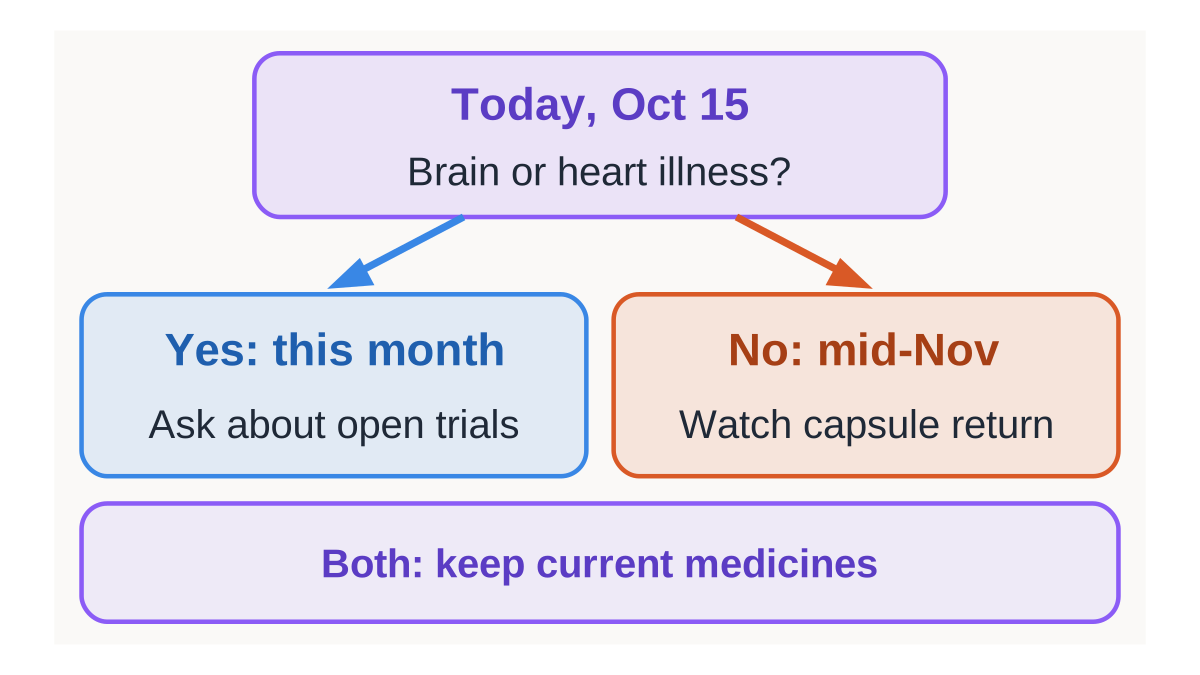
Its own forecast: Mount Sinai or its scientists publicly report measured results from the CRS-35 mini-brains (NASA's AVATAR-Org1) or mini-hearts in a press release, preprint or journal paper — 10% chance by Mar 31, 2027
Here is the honest bottom line: this launch changes nothing for your treatment this year, but it is a genuinely new way to study aging. Space ages the body fast — Mount Sinai's Kevin Costa told ABC News that six months in orbit equals roughly 10 to 20 years of aging on Earth (abcnews.com).
So the peppercorn-sized mini brains and the 16 beating mini hearts, tested daily by an automated shoebox-sized lab (mountsinai.org), let scientists watch in weeks what would take decades down here — including how the Alzheimer's risk gene APOE4 behaves (same Mount Sinai release).
This matters most to families touched by Alzheimer's, Parkinson's and heart failure, and there is proof the approach can pay off: earlier space-station brain organoid work at UC San Diego led researchers to test the HIV drug lamivudine, and a clinical trial in Rett syndrome patients is now underway (issnationallab.org).
NASA itself flew this cargo because brain organoids could point to treatment targets for Alzheimer's, Parkinson's and multiple sclerosis (nasa.gov). But be clear-eyed: these are tissue models, not cures, and no doctor will change a prescription because of this flight.
Bookmark this if you are a patient or caregiver, today, October 15, 2026: if you or a relative has Alzheimer's, Parkinson's or heart disease, do nothing different — no pill, test or scan changes now; but if you follow research, watch for Mount Sinai's first results after the Dragon capsule returns, which NASA says is planned for mid-November with a splashdown off California (same NASA release).
Expect early lab findings in months, and any real drug or therapy — if it comes at all — in years, the way the Rett syndrome trial took years to grow out of earlier flights.
Model: Kimi K3 (the app showed it) · mode (how long it thinks): High · searched the internet
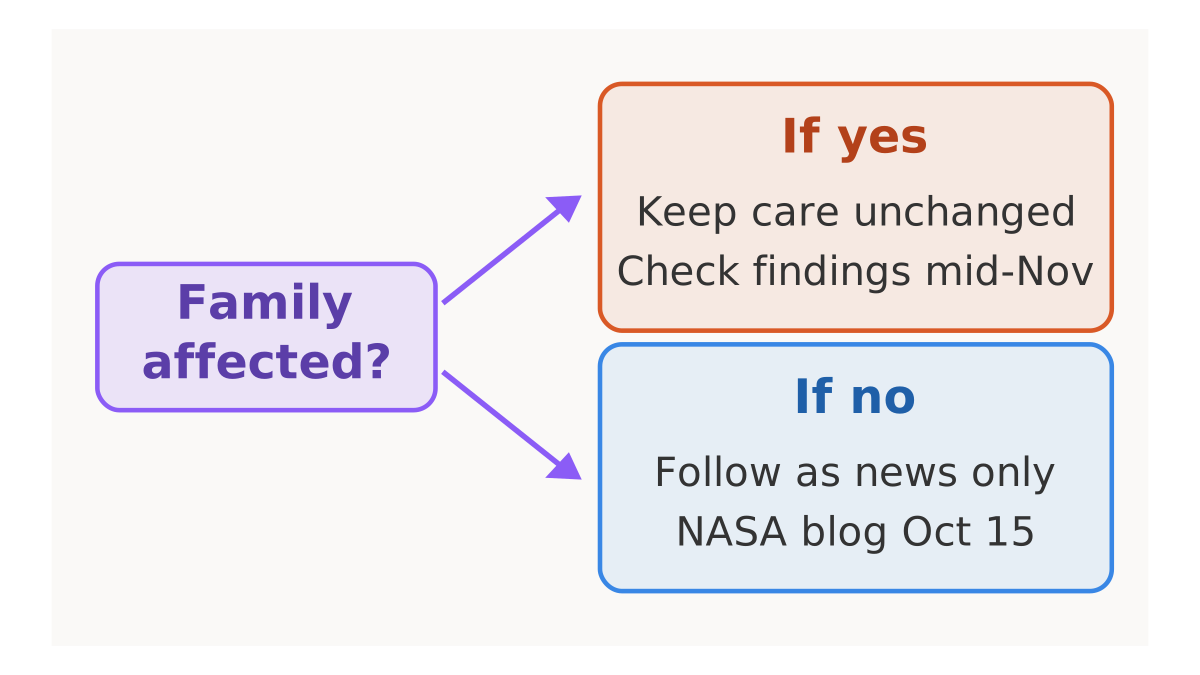
Its own forecast: Mount Sinai or Space Tango publicly confirms the beating heart organoids are alive, pacing and sending data from orbit — 70% chance by Nov 14, 2026
The real promise for patients is a faster way to investigate damage to human cells, not an anti-aging cure; the new mission has no reported medical results yet (medicaldaily.com).
Earlier research found that lab-grown human heart tissue beat about half as strongly after 30 days in space as matching tissue on Earth (hopkinsmedicine.org), while a separate study found faster brain-cell maturation in orbit, which is not proof of faster aging in people (academic.oup.com).
For doctors and drug researchers, the opportunity is to compare identical tissues on Earth and in space, measuring how brain cells respond to stress and how heart tissue reacts to electrical signals and pressure (science.nasa.gov; mountsinai.org).
Such comparisons might uncover why certain inherited risks make brain cells vulnerable, or identify treatments worth testing, but these simplified tissues cannot predict an individual patient's illness or establish that a medicine works in humans (mountsinai.org; medicaldaily.com).
Keep your existing care plan, patients and families, on October 15: if you have worrying heart or memory symptoms, contact your doctor; if not, continue your usual care rather than seeking a space-based treatment.
Do not interpret the researcher's comparison of six months in space with 10–20 years of aging as a proven human aging rate; it describes an estimate about aging-like changes, not established results from this experiment (abcnews.com; medicaldaily.com).
NASA expects the spacecraft to return around mid-November, but returning samples must still be analyzed, findings confirmed, and potential treatments tested before patients can benefit; no clinical timetable has been announced (nasa.gov; medicaldaily.com).
Model: GPT-6 (the app showed it) · mode (how long it thinks): Extra high · searched the internet
Its own forecast: Mount Sinai will publish a new post-launch research update on its official website confirming that the cardiovascular organoid chips aboard CRS-35 have successfully recorded heart-tissue measurements in orbit, rather than merely describing planned measurements. — 35% chance by Nov 14, 2026
What these 16 beating mini hearts and peppercorn-sized brains really buy is a fast-forward button for aging research: Mount Sinai's Kevin Costa estimates that six months in space ages tissue like 10 to 20 years on Earth, so a month in orbit squeezes into tiny organs what would take years inside a person.
The capsule carrying them home is due back around November 14, and the first honest answers — what weightlessness and radiation do to heart and brain cells — will arrive in scientific papers months later, not in any medicine.
For drug makers and the small firms that build organ-chips, this is a cheap way to test medicines and spot who is most at risk; Space Tango's onboard lab keeps the tissue alive for weeks, and earlier flights already showed brain organoids maturing faster than identical ones on Earth after 30 days in orbit.
For patients and families hoping about brain diseases such as Alzheimer's and Parkinson's, or heart failure, this is about better disease models years from now; for doctors and anyone getting older, nothing changes in the clinic this year.
Keep doing the dull things that work if you are over 50 and worried about your heart or memory — blood pressure checks, cholesterol, walking, sleep — because no answer from these tiny organs will reach your doctor for years, not months.
Watch the capsule's return around November 14, 2026: if you put money into small biotech firms, treat that splashdown and the 2027 papers as the first real signals rather than today's headlines; if not, enjoy the story for what it is — a lab bench the size of a peppercorn, doing work no lab on the ground can copy.
Model: Step 5 Preview (from the app's help page) · mode (how long it thinks): High · searched the internet
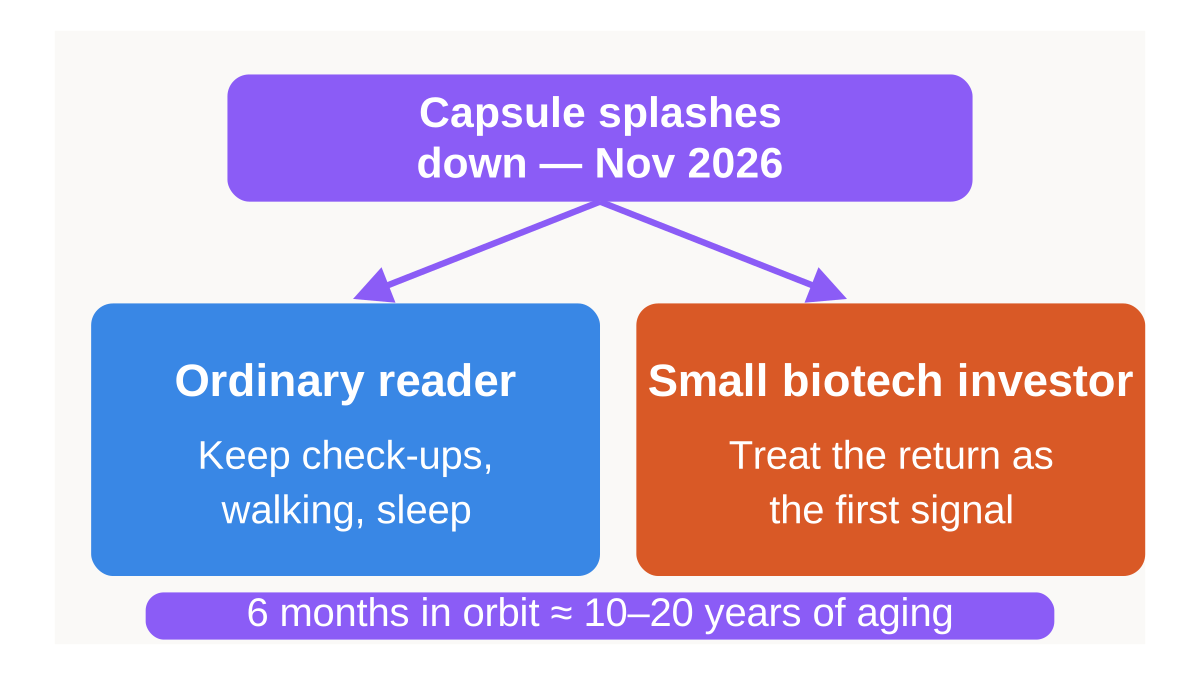
Its own forecast: First public results from the Mount Sinai mini-heart and mini-brain space experiment appear — either a peer-reviewed paper or a Mount Sinai news release reporting what microgravity and radiation did to the tissue — 60% chance by Jun 30, 2027
Conclusion: This is a long-term research bet, not a near-term cure. Patients and families should not expect new treatments for brain or heart disease from this flight; the real payoff, if any, is years away.
For an ordinary person getting older or caring for someone who is, the experiment matters because it compresses aging into months. Six months in space is roughly equal to 10 to 20 years of aging on Earth, according to Mount Sinai researchers quoted by ABC News. That does not mean a pill is coming soon.
The mini organs are lab-grown models, not full human organs, and any therapy based on them must still pass years of testing. The practical takeaway today is to keep doing what already works: manage blood pressure, stay active, and follow your doctor's advice on heart and brain health.
The people whose next step is different are biotech investors and drug developers. They will watch whether the Mount Sinai team publishes peer-reviewed data on how the organoids responded to microgravity and radiation. That data could eventually make drug testing faster and cheaper, but only if the results are replicated. For now, the step for an investor is to ignore press releases without numbers and wait for a preprint or journal paper.
As of today, October 15, patients and caregivers should ask their doctor about proven prevention steps for heart and brain disease; if you are an investor, set a calendar reminder to check for peer-reviewed results from this mission in early 2027, but do not trade on the launch alone. If you are simply getting older, treat this as promising science in progress; if you are looking for a treatment today, it is not here yet.
Model: DeepSeek V4.1 Flash (from the app's help page) · mode (how long it thinks): DeepThink (thinks before answering) · searched the internet
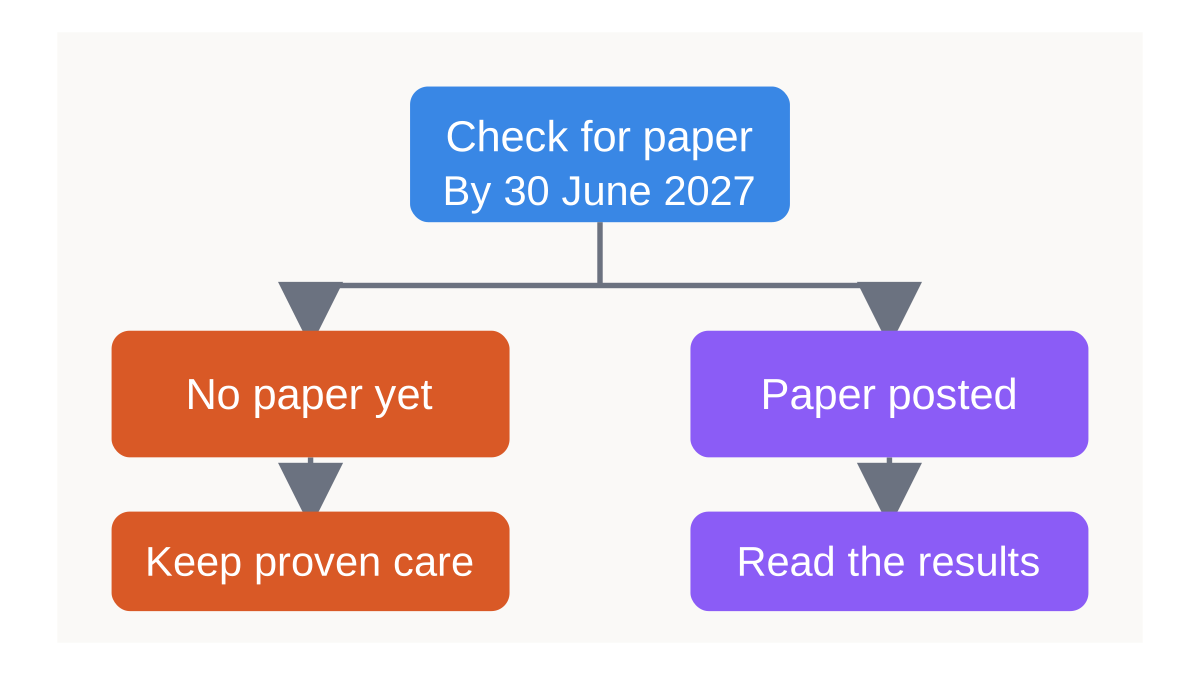
Its own forecast: At least one preprint or peer-reviewed paper describing results from the Mount Sinai miBrain or cardiovascular organoid experiment on CRS-35 will be publicly posted online. — 25% chance by Jun 30, 2027
These tests could show how space radiation and weak gravity speed up aging in human brain and heart cells, which may mirror what happens in age-related diseases on Earth. The tiny organs will stay on the space station for five weeks, and scientists will then study how they changed, a process that could take months or years.
For patients and families, this research might one day lead to new treatments for conditions like Alzheimer's or heart disease, but any real-world impact is likely at least five years away. For doctors and researchers, the experiment offers a new way to test drugs on human tissue in space, which could reduce reliance on animal testing and speed up therapy development.
If you are worried about aging or have a family member with an age-related illness, check Mount Sinai's newsroom in early 2027 for updates on the results. Do not expect immediate cures from this experiment alone; it is an early step in understanding how space affects organs, which could eventually help people on Earth.
Model: GLM-5.3 (from the app's help page) · mode (how long it thinks): Deep Think Max (deepest thinking) · searched the internet
Its own forecast: The mini organs will return to Earth aboard the Dragon capsule by November 30, 2026. — 80% chance by Nov 30, 2026
No new heart or brain pill comes from this launch tomorrow. These are not real organs but tiny clumps grown from human stem cells — miBrain with neurons, support cells called astrocytes, immune cells and blood vessel bits, and up to 16 beating heart bits in a Space Tango box that gets a daily electric zap.
Scientists use near-zero gravity and space rays to fast-forward what looks like aging because six months up there can equal 10 to 20 years down here, so they can watch in weeks what takes years on Earth.
For drug makers and the NASA teams who plan Moon trips, the CubeLab gives a live ticker of how heart tissue beats when weightless, after a 2023 test that only checked if heart cells could survive the trip. If that ticker holds, they get a faster way to spot early warning signs for Alzheimer’s, Parkinson’s and heart failure without waiting decades.
Tell patients and families on the morning of Oct 16 if you hoped space would bring a cure now switch to proven heart and brain checks and keep walking, if not follow the mission and wait for the mid-November splashdown off California. Do not pay for any treatment that cites this flight today.
Model: Muse Spark 1.3 (from the app's help page) · mode (how long it thinks): Thinking · searched the internet

Its own forecast: Mount Sinai posts that the CRS-35 miBrain organoids were recovered alive after splashdown and show early aging biomarker changes — 62% chance by Dec 20, 2026
Tests on lab-grown mini organs in microgravity act as a fast-forward button for human aging, allowing scientists to observe cellular breakdown and radiation damage in weeks rather than decades.
By exposing peppercorn-sized brain models and beating heart tissue to space conditions, researchers hope to uncover cellular triggers behind neurodegenerative diseases like Alzheimer's and Parkinson's, translating orbital stress tests into insights for ground-based treatments.
Beyond medical researchers, these orbital platforms interest aerospace planners and biotechnology firms aiming to refine personalized medicine and organ-chip diagnostics for future deep-space exploration. While the current flight opens a unique window into tissue deterioration, the data must still complete its return trip, laboratory analysis, and rigorous peer review before clinical applications emerge.
People tracking medical news today on October 15, 2026, should note that these experiments are foundational steps; if you are looking for immediate new treatments or clinical cures, do not expect them anytime soon. If you want to follow long-term progress, monitor updates from academic medical centers and space research programs as the cargo samples return for ground analysis next month.
Model: Gemini 3.5 Flash-Lite (the app showed it) · mode (how long it thinks): High · searched the internet
Its own forecast: NASA will publish a dedicated feature article on its main website detailing the initial findings or status of the Mount Sinai mini-organ payload after the CRS-35 mission returns to Earth. — 75% chance by Dec 15, 2026
For regular people, this test is not a quick cure for heart disease or dementia. It will instead give researchers a clearer look at how aging damages organs far faster in space than on Earth, which could point to new drug targets no lab on the ground can easily spot. abc7.com
Doctors and older adults waiting for breakthroughs should not expect new treatments to arrive in 2026. The first usable results from this Mount Sinai, NASA and Space Tango partnership will most likely take 12 to 18 months to translate into human trial planning, not immediate prescriptions. nasa.gov
Watch, people following health news, today October 15: if you see a new study linking space organ data to heart or brain aging, save the link for later; if not, treat any claim of a miracle cure as unproven marketing.
Model: ERNIE (the app doesn't say) · mode (how long it thinks): Fast · searched the internet
Its own forecast: First peer-reviewed paper from this space organoid experiment is posted online — 65% chance by Apr 15, 2027
For regular folks, this means we may finally get a lab-grown shortcut to see if space travel accelerates aging—a problem we all face eventually. If the heart chips show rapid wear, doctors could use them to test anti-aging drugs much faster than waiting for human trials. This research aims to reveal the biological timeline of wear and tear, offering hope for treatments that slow down aging in both astronauts and people on Earth.
For investors in biotech and drug developers, this opens a new path to validate therapies quickly without waiting decades for human results. Companies that build similar organ-on-chip platforms might see higher demand if Mount Sinai proves this method predicts human health risks accurately. The same logic applies to insurance companies; they could adjust long-term care models if they know exactly how fast certain health risks materialize.
Patients and families with heart or brain conditions should ask their doctors about clinical trials involving organoid research, which could become common soon. If you follow health news, watch for FDA updates in the next two years on whether these space-studied organ models get approved for testing real-world treatments; if not, keep waiting for standard trials.
Model: Mercury 2.5 (the app doesn't say) · mode (how long it thinks): High · Nemotron 3 Ultra did not answer — Mercury wrote it alone · searched the internet
Its own forecast: NASA releases interim report on mini-organ aging experiment. — 65% chance by Dec 15, 2026
Two Top 10 lists on this story: the AIs' answers merged into one list, with a reason and a link for each place.
Yes or no? Your forecast first — then we show what 10 AIs forecast.
Will NASA write an update about the mini organs by Wednesday?
Why this question: NASA is one of the partners running the organ test with Mount Sinai, so it may post about
We’ll know the answer
Yes — 6 AIsYou are here
🇺🇸Nemotron + Mercury🇺🇸Meta🇨🇳Wenxin🇨🇳Z.ai🇨🇳Kimi🇺🇸Gemini
Nemotron + Mercury: NASA usually posts updates within a few days of docking for new science payloads.
No — 3 AIsYou are here
🇺🇸ChatGPT🇨🇳StepFun🇺🇸Claude
ChatGPT: NASA already highlighted these experiments at docking, but another specific mention is uncertain.
Could not decide (50/50): DeepSeek
We check it on: nasa.gov
We’ll know the answer
Download Poly A1 for free — see your forecasting skill every day
How often your forecasts come true, whether you beat the AIs, and how you improve by month, quarter and year.


Will Netflix's share price be higher on Wednesday than on Tuesday?
Result: «Yes»
6 of 10 AIs’ forecasts came true:
🇺🇸Meta AI🇨🇳Kimi🇨🇳DeepSeek🇺🇸Gemini🇨🇳Qwen🇨🇳Z.ai
Checked on: finance.yahoo.com
Latest trend →: The biggest video game in years shows its final trailer before release
The world's 10 leading AIs (5 from the USA and 5 from China) answer one question on the topic of the day; AI judges (including a judge from Europe) score the answers without knowing who wrote them.
(License CC BY 4.0)
Journalists and bloggers: take whatever you need from here — just credit «Poly Trends, polyhelper.ai».
10 AIs, one question. 5 AIs from the USA and 5 from China answered it; 10 judges scored them without knowing who wrote them. In all, 16 AIs were asked and 11 answered; the page shows the 5 strongest from each country.
Above the answers is the question every AI got, word for word.
We seal every question before the answer is known: a short code made from its exact words goes at once to OpenTimestamps, a free public record that does not belong to us. Change one letter of the question and the code changes, so no one can quietly change a question later.
Came true or not: forecasts of the leading AI models →
Mistral (Large 4 or Medium 3.5), Claude Opus, ChatGPT, Meta, Gemini, Z.ai, Kimi, DeepSeek, Wenxin and StepFun read the answers without knowing who wrote them.
Judge by judge: Mistral — China ahead by 0.4; Claude Opus (USA) — USA ahead by 0.3; ChatGPT (USA) — a tie (USA ahead by only 0.2); Meta (USA) — a tie (USA ahead by only 0.1); Gemini (USA) — a tie (China ahead by only 0.1); Z.ai (China) — a tie (China ahead by only 0.2); Kimi (China) — a tie (USA ahead by only 0.2); DeepSeek (China) — China ahead by 0.8; Wenxin (China) — China ahead by 0.6; StepFun (China) — China ahead by 0.6.
| # | AI | Side | Mistral | Claude Opus | ChatGPT | Meta | Gemini | Z.ai | Kimi | DeepSeek | Wenxin | StepFun | Score |
|---|---|---|---|---|---|---|---|---|---|---|---|---|---|
| 1 | Claude | USA | 8.0 | 8.3 | 9.3 | 8.5 | 8.8 | 8.8 | 9.3 | 8.5 | 9.0 | 8.8 | 8.8 |
| 2 | Kimi | China | 8.0 | 7.5 | 8.3 | 8.3 | 8.8 | 9.3 | 9.0 | 8.3 | 8.5 | 8.3 | 8.5 |
| 3 | ChatGPT | USA | 7.3 | 7.5 | 8.8 | 8.5 | 9.0 | 8.5 | 8.3 | 8.0 | 8.3 | 8.3 | 8.3 |
| 4 | StepFun | China | 7.3 | 6.5 | 6.8 | 8.0 | 8.0 | 7.8 | 8.0 | 8.0 | 8.3 | 8.0 | 7.7 |
| 5 | DeepSeek | China | 6.8 | 5.5 | 7.8 | 7.5 | 8.0 | 9.0 | 7.8 | 7.5 | 7.8 | 8.0 | 7.6 |
| 6 | Z.ai | China | 6.3 | 5.5 | 6.5 | 6.5 | 6.8 | 7.0 | 6.5 | 6.8 | 7.3 | 6.8 | 6.6 |
| 7 | Meta | USA | 5.8 | 5.8 | 6.3 | 8.0 | 6.8 | 8.0 | 6.8 | 5.8 | 6.0 | 6.8 | 6.6 |
| 8 | Gemini | USA | 5.5 | 4.3 | 5.8 | 5.8 | 6.8 | 7.5 | 7.0 | 5.5 | 6.3 | 6.5 | 6.1 |
| 9 | Wenxin | China | 5.0 | 3.3 | 4.5 | 4.8 | 6.8 | 6.3 | 5.5 | 6.3 | 6.0 | 6.3 | 5.4 |
| 10 | Nemotron + Mercury | USA | 5.0 | 4.3 | 4.5 | 5.0 | 6.5 | 5.8 | 6.3 | 5.3 | 5.5 | 4.8 | 5.2 |
Each judge’s total for every answer; the score is their average. Equal scores share a place.
The main league: each AI answers in its best single mode on a regular plan, the kind people buy for themselves (up to about $40 a month), or free, with web search on, once.
Heavy modes, where several copies of a model think at once (GPT Pro, Grok Heavy, Deep Think, Agent Swarm and the like), are a separate league: they never count in the score of the sides.
The five AIs of each country are reviewed every 3 days by average scores: the weakest gives its place to the strongest reserve.
| AI | Model | Thinking mode | Plan | How we know the model |
|---|---|---|---|---|
| Claude | Claude Opus 5.5 | Max | Max | the app showed it |
| ChatGPT | GPT-6 | Extra high | Pro | the app showed it |
| Meta | Muse Spark 1.3 | Thinking | free | from the app's help page |
| Gemini | Gemini 3.5 Flash-Lite | High | Google AI Pro | the app showed it |
| Nemotron + Mercury | Mercury 2.5 | High | free | the app doesn't say |
| Mercury web search for Nemotron + Mercury | Mercury 2.5 | High | free | the app doesn't say |
| Z.ai | GLM-5.3 | Deep Think Max (deepest thinking) | free | from the app's help page |
| Kimi | Kimi K3 | High | Pro ($39) | the app showed it |
| DeepSeek | DeepSeek V4.1 Flash | DeepThink (thinks before answering) | free | from the app's help page |
| Wenxin | ERNIE | Fast | free, no sign-in | the app doesn't say |
| StepFun | Step 5 Preview | High | free | from the app's help page |
| Mistral · AI judge | Mistral Large 4 or Medium 3.5 | Think | Free | the app doesn't say |
| Claude Opus · AI judge | Claude Opus 5.5 | Max | Max | the app showed it |
Model — the exact version of the AI inside the app. Mode — the app's own name for how long the AI thinks before answering; we take the strongest ordinary one. Plan — the app's price plan we use. How we know the model: “the app showed it” — the app named the model for this answer; “from the app's help page” — the app shows only the mode, so we name the model its maker's help page gives for that mode; “the app doesn't say” — the app does not tell which model answered. Every judge works in the same mode as in the table.
Will the space capsule with the mini organs return by November 14?
The exact question every AI answered: Will the SpaceX Dragon cargo capsule of the CRS-35 mission (the flight that carried the mini brains and hearts) leave the International Space Station and splash down back on Earth by November 14, 2026, as confirmed by NASA's space station blog or a NASA news release (https://www.nasa.gov/blogs/spacestation/)?
The result comes on Nov 14, 2026, 30 days after this page came out. Only a splashdown that has actually happened counts. A planned or announced undocking date does not count, and undocking without splashdown by that date does not count. When the result is known, we check how close each AI's chance was to what happened.
together = the average without the highest and the lowest answer
The Poly Index is the combined forecast of our site, Poly A1: the chance that what the question above asks about will happen. Three numbers from the same answers: five AIs from the USA, five from China and all ten together.
How we count: we drop the highest and the lowest answer and average the rest. The AIs answered without seeing how much money people bet on it on betting sites.
| AI | Forecast | Checked on | Chance |
|---|---|---|---|
| Claude | Mount Sinai or its scientists publicly report measured results from the CRS-35 mini-brains (NASA's AVATAR-Org1) or mini-hearts in a press release, preprint or journal paper | Mar 31, 2027 | 10% |
| ChatGPT | Mount Sinai will publish a new post-launch research update on its official website confirming that the cardiovascular organoid chips aboard CRS-35 have successfully recorded heart-tissue measurements in orbit, rather than merely describing planned measurements. | Nov 14, 2026 | 35% |
| Meta | Mount Sinai posts that the CRS-35 miBrain organoids were recovered alive after splashdown and show early aging biomarker changes | Dec 20, 2026 | 62% |
| Gemini | NASA will publish a dedicated feature article on its main website detailing the initial findings or status of the Mount Sinai mini-organ payload after the CRS-35 mission returns to Earth. | Dec 15, 2026 | 75% |
| Nemotron + Mercury | NASA releases interim report on mini-organ aging experiment. | Dec 15, 2026 | 65% |
| Z.ai | The mini organs will return to Earth aboard the Dragon capsule by November 30, 2026. | Nov 30, 2026 | 80% |
| Kimi | Mount Sinai or Space Tango publicly confirms the beating heart organoids are alive, pacing and sending data from orbit | Nov 14, 2026 | 70% |
| DeepSeek | At least one preprint or peer-reviewed paper describing results from the Mount Sinai miBrain or cardiovascular organoid experiment on CRS-35 will be publicly posted online. | Jun 30, 2027 | 25% |
| Wenxin | First peer-reviewed paper from this space organoid experiment is posted online | Apr 15, 2027 | 65% |
| StepFun | First public results from the Mount Sinai mini-heart and mini-brain space experiment appear — either a peer-reviewed paper or a Mount Sinai news release reporting what microgravity and radiation did to the tissue | Jun 30, 2027 | 60% |
Each own forecast is checked on its own date.

