Street Fighter is a martial arts action film from 1994, based on the Capcom video game series. It was one of two films that year built on Street Fighter II. The other was an animated movie. Steven E. de Souza wrote and directed it. Jean-Claude Van Damme and Raul Julia lead the cast, and it was Julia's last film role in theaters. Byron Mann, Damian Chapa, Kylie Minogue, Ming-Na Wen and Wes Studi play supporting parts. It opened in New York and Los Angeles on December 23, 1994.
In the story, a war rages in Thailand. General M. Bison, a drug lord who rules Shadaloo, fights the Allied Nations, led by Colonel William F. Guile. Bison grabs 64 aid workers and demands a ransom of US$20 billion within three days. Guile refuses and swears to bring Bison to trial. One of the captives is Guile's friend Carlos "Charlie" Blanka. Bison sends him to a scientist, Dr. Dhalsim, to become the first of a new kind of supersoldier. The process leaves Charlie badly disfigured, but Dhalsim secretly changes his programming so he keeps his humanity.
Meanwhile, two American con artists and fighters, Ryu Hoshi and Ken Masters, try to cheat the arms dealer Viktor Sagat with fake weapons. Guile arrests them and offers freedom if they help him find Bison, since Sagat supplies Bison's weapons. They stage a prison escape and fake Guile's death to win Sagat's trust. A reporter, Chun-Li Zang, whose father Bison killed twenty years earlier, joins the plan with her crew, Edmond Honda and Balrog. Against Guile's wishes, they try to kill Bison and Sagat at a party. Ryu and Ken stop them to keep the warlords' trust, which exposes the group.
Bison welcomes Ryu and Ken into his organization, jails and tortures Honda and Balrog, and has Chun-Li brought to his quarters. Ryu and Ken free the prisoners and race to Bison, who is fighting Chun-Li. He escapes and gasses them all to sleep. The Allied Nations decide to pay the ransom, but Guile goes ahead with his attack anyway. At the base, a guard finds out about Dhalsim's trick, and Blanka kills the guard to protect him. Guile arrives and nearly shoots Charlie to end his pain, but Dhalsim stops him.
When the deadline passes, Bison plans to set Charlie loose on the hostages. Guile bursts out and fights the guards until the rest of the Allied forces arrive. Bison and Guile end up facing each other and agree to a one-on-one duel. Ryu and Ken beat Sagat and Vega. Dee Jay, Bison's computer expert, runs off with Sagat. Zangief, Bison's bodyguard, fights Honda but switches sides after Dee Jay tells him Bison is the real enemy.
Guile kicks Bison into a bank of hard drives and shocks him. A revival system brings Bison back, and his suit turns out to have first-aid features, electric weapons and boots that let him fly. He beats Guile down, until Guile kicks him into a wall of monitors that explodes. The hostages are freed. Dhalsim and Charlie refuse to leave, because Dhalsim wants to make up for what he did to Charlie. Guile escapes the exploding base. In a scene after the credits, solar power restarts the base and Bison's fist pushes up through the rubble.
The film cost ¥4 billion, which is $35 million. Capcom paid most of it and had to approve everything. They demanded a December 1994 release, so the schedule was tight. De Souza says he wrote the first script draft overnight, after learning Capcom's executives were in Los Angeles at short notice. He was also a fan of the game.
Capcom had long wanted Van Damme as Guile, and his fee took nearly $8 million of the budget. Steven Seagal had earlier been signed for the part. Julia said he took the role of Bison because his children loved the games. With most of the casting money gone, many other roles went to little-known actors. Minogue got the part of Cammy because the Australian Actors' Guild wanted de Souza to hire an Australian, and Cammy was the last role open. Capcom wanted the Japanese actor Kenya Sawada as Ryu, but de Souza kept Mann.
Benny Urquidez, a karate champion, trained the cast and also played one of Sagat's henchmen. Stunt coordinator Charlie Picerni wanted plenty of training time. That plan fell apart when the team learned Julia had cancer and could not be shown in his weak state. So the cast trained only shortly before their scenes, sometimes just hours before. De Souza said he wanted a mix of Star Wars, James Bond and a war movie. He avoided the games' supernatural powers, hinting at them for a sequel instead.
Filming took place in Queensland, Australia, mostly on the Gold Coast, with studio work in Brisbane. Some outdoor scenes were shot in Bangkok, standing in for Shadaloo City. Unrest in neighboring Myanmar kept de Souza from using helicopters in the final attack, so the troops come by boat.
The first cut got an R rating, which Capcom would not accept, as they had wanted PG-13 from the start. After cuts, de Souza says it received a G, and one added swear word lifted it to PG-13. The post-credits scene was left out of cinemas out of respect for Julia, but it appears on home video.
The soundtrack came out on December 6, 1994, mostly rap and hip-hop. It reached No. 135 on the Billboard 200. Graeme Revell wrote the orchestral score, played by the London Symphony Orchestra. It includes playful nods to Bizet's Carmen and to the theme of Tombstone.
The film earned $9,508,030 in its opening weekend, placing third. It made $33,423,521 in the United States and $66,000,000 abroad, for $99,423,521 worldwide. Home video and TV added to the profit, and Capcom earned ¥15.5 billion, or $165 million, in total. At a 2024 shareholder meeting, Capcom said it still brings in tens of millions of yen each year.
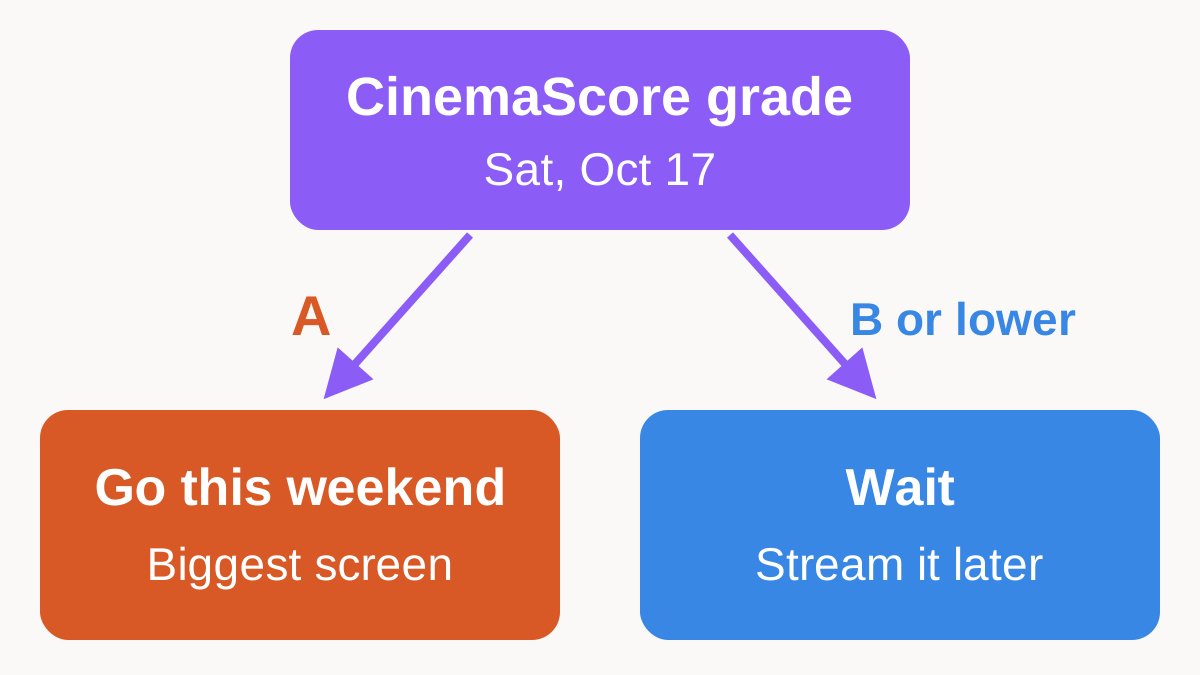
Critics were harsh. Rotten Tomatoes shows 20% positive reviews from 90 critics, and Metacritic gives 34 out of 100. Audiences gave it a B−. Reviewers disliked the camp tone, the noise and the weak story, though many praised Julia. Time and GameTrailers both put it on worst video game movie lists. It still earned two Saturn Award nominations, including a posthumous one for Julia.
The film led to a DC comic, a Japanese manga and two video games called Street Fighter: The Movie. A sequel was discussed in 2003 but never happened. The 1995 animated series borrowed several film ideas. A 2009 film, The Legend of Chun-Li, was received worse. In 2023, Legendary got the film rights for a new movie, now set for October 16, 2026, from Paramount.
Text and photos: en.wikipedia.org · 23.12 — original →