Tech Layoffs 2026 AI: 10 Giants Cutting Jobs, Spending More
- Oracle layoffs 20261
- Meta layoffs 20262
- Microsoft layoffs and buyouts 20263
- Amazon layoffs 20264
- Google layoffs and buyouts 2026 (Alphabet)5
Trend of the day · Work & educationWork & education

Microsoft's buyout is ordinary severance pay, and it expects far fewer than 60,000 people to take it.
On October 26, 2026, Microsoft offered a voluntary buyout to about 60,000 employees in the United States, Canada, India and the United Kingdom. A voluntary buyout is money paid to staff who choose to leave. That is more than a quarter of the company's staff worldwide.
Employees must decide in December, and leavers go on December 31. It is Microsoft's second offer of this kind this year, as it spends record sums on artificial intelligence (source).
What does this mean for people who work in office and technology jobs, at Microsoft and at other large companies around the world? What is likely to happen next? What should people like the readers of this page do now, whether they are employees, job seekers, or businesses that rely on Microsoft?
In plain words: Microsoft — American maker of Windows, Office and cloud services; voluntary buyout — money paid to staff who choose to leave; Reuters — a worldwide news agency based in London
Ask your Microsoft contact in writing who covers your account after December 31.
60,000 people got a cash exit offer at Microsoft; the deadline is early December and leavers go December 31.
What not to do: Don't assume 60,000 will leave or that support will collapse; neither is confirmed.
Big companies now pay people to leave instead of firing them. Microsoft's package is ordinary severance, not a windfall. Office workers elsewhere should expect the same tool at their own employers.
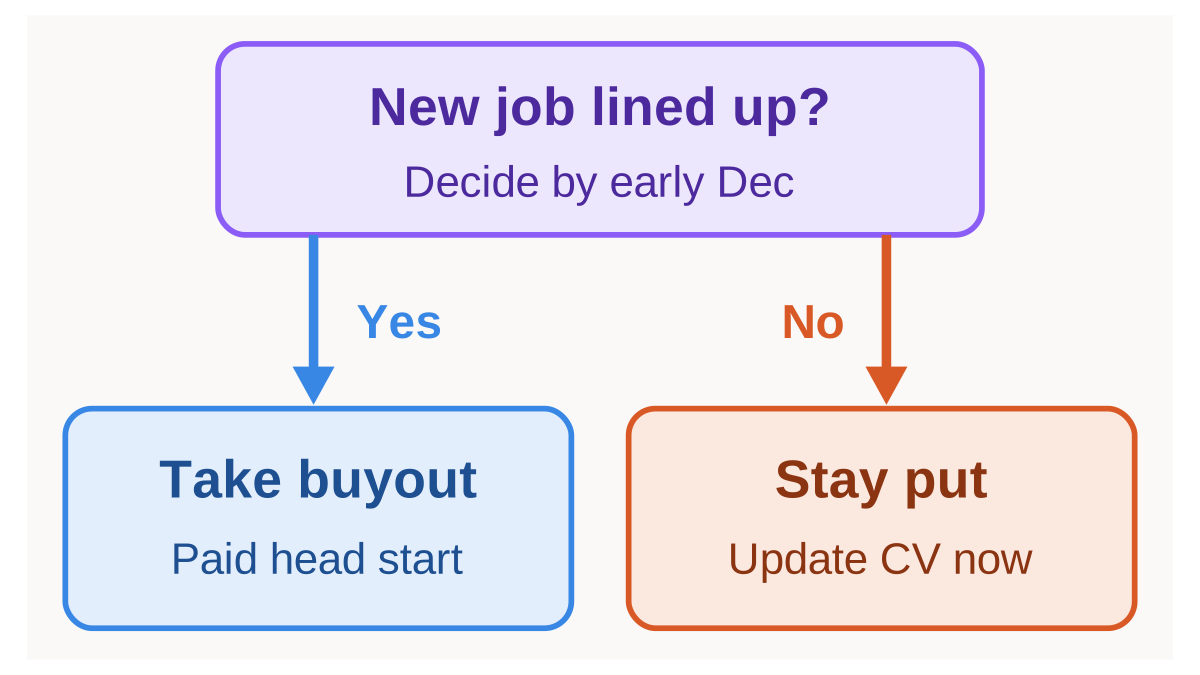
It is a good deal only for people already half out the door. Layoffs are still possible, and many more people than usual may be job hunting in January. Eligible staff should price weeks of pay, health cover and stock against a realistic job search before the early-December deadline; if you were not planning to leave, staying is reasonable.
Update your CV and name one task you do with AI, this week. If your employer is buying AI tools, show you can finish whole tasks with them; if not, still keep your results written down. Businesses that rely on Microsoft should ask their account contact in writing who covers them after December 31.
This is what most AIs advise. Each AI explains it in its own words below.
Most of the answers agree on the direction. Microsoft is moving money from salaries to AI data centers, and paying people to leave is the softer way to do it. Sales and security teams are left out, while Copilot, Windows, Xbox, finance and HR are in.
Most also agree that 60,000 people are eligible, not 60,000 leavers. The package is standard severance, without the extra health cover of last spring's retirement deal. Microsoft itself expects fewer takers than the roughly 30% who accepted in spring.
The split is over numbers and effects. StepFun and Kimi scale the spring rate to 18,000–20,000 leavers and a January flood of experienced job seekers. Claude, ChatGPT, Meta and Grok stress the company's lower expectation.
One answer, Wenxin, expects rivals like Google or Amazon to copy the offer within weeks. Others treat that as possible, not certain. Service for customers is also disputed: most expect thinner support, while ChatGPT notes Microsoft picks teams partly by customer commitments.
What comes next is the earnings report on Wednesday, October 28, after the market closes. It should show Azure growth near 45%, more than $50 billion of quarterly data-center spending, and possibly the cost of the offer. Layoffs stay possible if too few people accept.
They split: StepFun and Kimi assume 18,000–20,000 leave; others say far fewer.
What settles the dispute: The actual number who accept by early December will show who is right.
No clear split: US and China AIs share the facts, but only some China AIs build 18,000-leaver scenarios.
What is confirmed and what is not
The AIs cited 36 sources
Ask any AI yourself
I work in an office job at a big company. Should I update my CV now and which AI skills should I show?
Copy it and paste it into a chat with any AI
Who wins, who loses: Cash-ready leavers and AI-skilled staff gain; routine office roles lose security.
Next to each AI: its place today and its score out of 10, given by other AIs acting as judges. Tap an answer to read it.
For office and tech workers, the big change is that the giant companies are now paying people to leave on their own instead of only firing them, and money is moving from salaries to AI computers. Microsoft's package equals its normal severance (pay based on years worked, stock that keeps vesting, a period of health cover) and lacks the extra health cover of last spring's retirement deal.
The company expects fewer takers than the roughly 30% who accepted then, and says firings stay possible (calcalistech.com).
This is not just Microsoft: about 196,000 tech workers have been hit by layoffs in 2026 so far, according to one tracker (techrepublic.com), and Meta cut about 8,000 jobs in May (france24.com).
Businesses that use Microsoft products should expect changes mainly in Xbox, Windows, Copilot, finance and HR teams, which are taking part. Sales and security staff are left out (investing.com), so your sales contacts should mostly stay the same.
People who own Microsoft shares get the next clue on Wednesday, October 28, after the market closes. The company has promised spending of over $50 billion on data centers that quarter and about 45% growth for its Azure cloud rental business (fool.com).
Read the offer email this week, Microsoft workers, and decide before the deadline in the first week of December. If you were already planning to leave or have a job lined up, the package is a paid head start; if not, staying is reasonable, but update your CV now, because the company has not ruled out layoffs (calcalistech.com).
Job seekers should expect more experienced Microsoft people on the market from January, so apply early. Businesses should ask their Microsoft contact by mid-December who will handle their account after December 31.
Its own forecast: Amazon, Alphabet, Meta or Oracle announces, or Reuters, Bloomberg or CNBC reports, job cuts or a buyout offer covering at least 1,000 of its employees — 45% chance by Nov 25, 2026
The biggest warning for office workers is that even jobs building artificial intelligence are not sheltered from cost cutting. Microsoft's offer reaches its Copilot, finance, human resources and Windows teams, yet 60,000 eligible employees does not mean 60,000 departures; Microsoft expects a smaller share to accept than the roughly 30% who accepted its earlier retirement offer (investing.com; geekwire.com).
My expectation is that other large employers will increasingly reward workers who can use artificial intelligence to complete whole tasks, rather than simply produce routine documents or reports.
For job seekers, the immediate risk is tougher competition if experienced Microsoft employees enter the market.
For businesses relying on Microsoft, the concern is continuity: the company says it is selecting participating teams partly according to customer commitments, while keeping involuntary layoffs available (blogs.microsoft.com; geekwire.com). I expect more restructuring, but not necessarily poorer service or fewer technology jobs everywhere.
Check your options by October 27: employees, if offered a buyout, compare its cash, health coverage and share payments against the cost of finding another job; if not offered one, update your resume and demonstrate one useful task you can complete with artificial intelligence. Job seekers should build a small portfolio showing measurable results rather than collecting certificates.
Businesses should identify their most critical Microsoft services, verify backup arrangements and ask their account representatives whether support contacts or service commitments will change; the company says participating groups vary according to customer needs (blogs.microsoft.com).
Its own forecast: By November 25, 2026, a major news outlet will report that Microsoft expects fewer than 10,000 employees to accept its new voluntary exit offer. — 62% chance by Nov 25, 2026
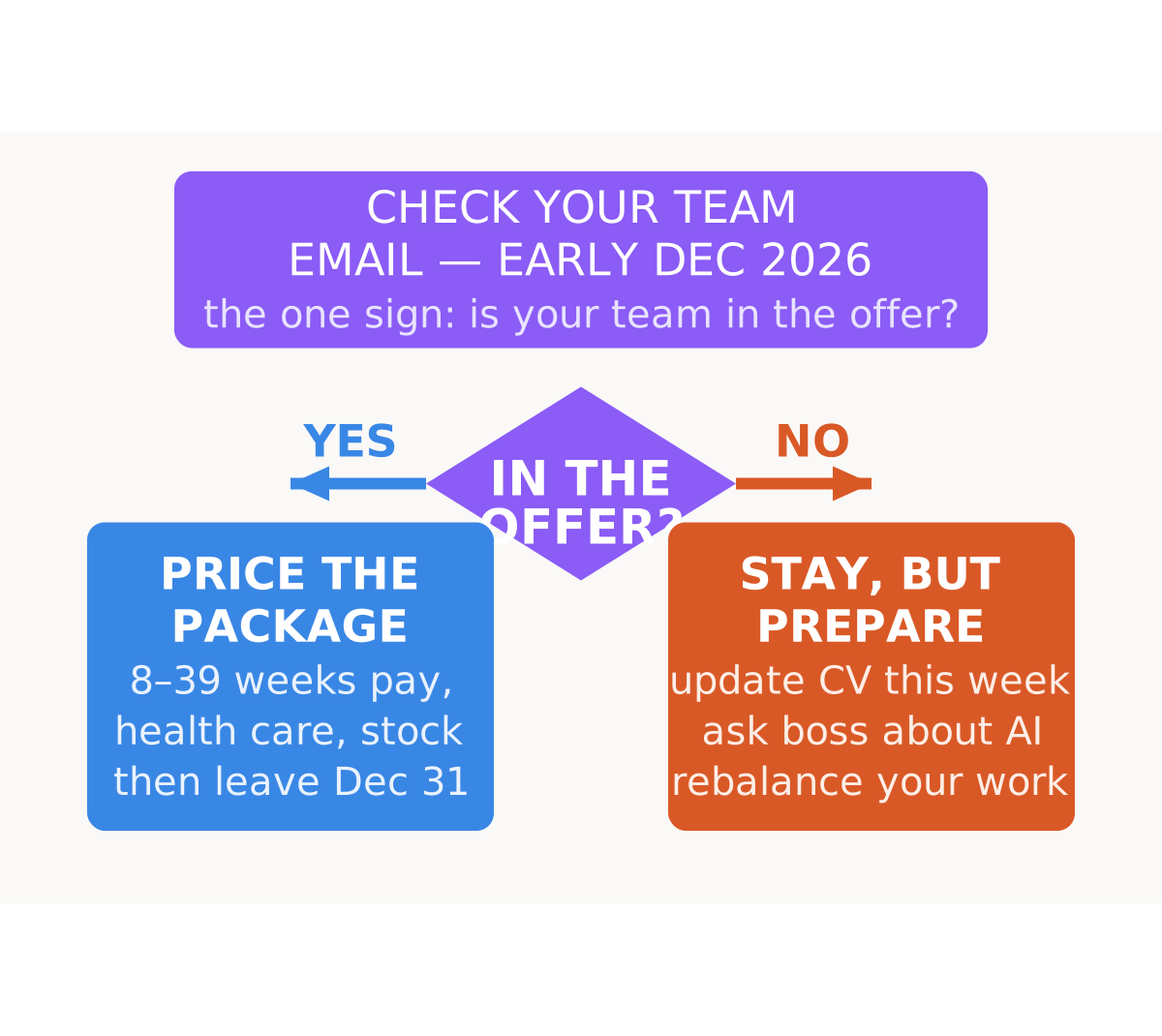
This is a quiet shrinking, not a wave of pink slips: about 60,000 people — roughly 27% of Microsoft — can take standard severance (in the US, eight to 39 weeks of pay under the terms used this year) and leave on December 31.
But only some teams may apply; sales, parts of engineering and the data-center groups are fenced out. Last time Microsoft did this, about one in three eligible employees said yes — if that repeats, some 20,000 people walk out by New Year, just as the company spends over $50 billion on AI computers in a single quarter.
For anyone in an office or tech job elsewhere, this is the new playbook: big companies now pay people to leave instead of firing them, because AI spending is eating the payroll budget. Job seekers should get ready for thousands of ex-Microsoft people — many senior — hitting the market in January.
Businesses that run on Microsoft software should expect their account managers and support contacts to change around year's end, and slower updates to older products as the people who know them leave.
Act today, Monday, October 26, office workers: if your team is in the offer and you were already half out the door, price the package — weeks of pay, health care, stock vesting — against staying, before the early-December deadline; if your team is out or you want to stay, stay, but update your CV this week anyway, because January brings both open jobs and fresh competition.
Its own forecast: In its quarterly report or an SEC filing for the October–December 2026 period, Microsoft discloses a one-time charge of $1 billion or more tied to the new Voluntary Exit Offer — 50% chance by Jan 31, 2027
The real news is not the money, it is the direction: Microsoft has decided that people, not computers, are the cost it can cut. It is paying staff to leave in the same year it expects to spend about $175 billion on data centres and chips, and the same trade is being made at Amazon, Oracle and Barclays.
For anyone in an office or technology job, that means your work is now weighed every quarter against what a smaller team plus software can do — and the people offered the money first are the ones whose jobs are easiest to describe on a chart.
Investors get the number two days from now: Microsoft reports on Wednesday, October 28, and the market will stare at cloud growth and at the more than $50 billion it plans to spend on data centres this quarter.
Companies that run on Microsoft's cloud have a different worry — the divisions offered the exit include the teams behind Copilot, Windows, Xbox, finance and human resources, so support and account staff may be thinner after December 31. Hiring managers and job seekers should watch the calendar instead: if even a third of the 60,000 take the money, about 18,000 experienced people start looking for work on the same day, December 31.
Microsoft staff and anyone with an office job: before you check your email on Tuesday, October 27, set your own rule — if you are eligible and the offer covers at least a year of your pay, take it and start looking in November; if you are not eligible, do not wait for a second round, because Microsoft's own memo says there are no plans for another one, so update your CV, save three months of pay and learn the tools your company is buying instead of you.
Watch Wednesday's results for two numbers: how fast the cloud business is growing, and how much the buyout will cost — the first tells you whether the cuts keep coming everywhere, the second tells you how serious this is. And if your employer starts using the words "efficiency" and "AI" in the same sentence, ask in writing what happens to your team in 2027.
Its own forecast: By January 31, 2027, Microsoft or one of Reuters, Bloomberg, CNBC and Business Insider gives a number for how many of the 60,000 employees accepted the October voluntary exit offer, and the number is 18,000 or more. — 50% chance by Jan 31, 2027
Microsoft is trading people for computers. It wants to cut office payroll to pay for AI data centers, and it asks people to leave on their own so it avoids a layoff headline. For office and tech workers everywhere, that means a lot of experienced people will be job hunting at once in January, and other big companies may copy the same tool.
Businesses that run on Microsoft tools feel it differently. If your support contact is in Copilot, Windows, Xbox, finance or HR, they may take the cash and leave at year end, while sales and security teams are not in the offer. That means slower answers and lost know-how in winter, right when budgets reset.
Check workers tonight, October 26, if you got the email from chief people officer Amy Coleman; if you are eligible at level 70 and below in the US, Canada, India and UK and your team is in, get your personal severance terms and note the early December decision date and December 31 exit; if not, save your key Microsoft contacts and docs this week before they go.
Its own forecast: Microsoft will publicly disclose the number or share of employees who accepted the 60,000-person Voluntary Exit Offer — 55% chance by Jan 31, 2027
This is a clear sign that Microsoft is reshaping its workforce to pour even more money into artificial intelligence (AI), not because it is in trouble but because it is choosing where to bet.
People who work in office and tech jobs at Microsoft and rivals should expect more pressure to take buyout deals or face leaner teams, especially in roles that overlap with what AI can now do. If you are a Microsoft employee reading this on Monday October 26, update your résumé today; if you are not, watch for rivals like Google or Amazon to offer similar deals within weeks.
Businesses that rely on Microsoft software or cloud services face a quieter risk: fewer support staff and slower feature rollouts in the short term, even as Microsoft doubles down on AI products that could eventually help those same businesses.
Parents of tech workers and small-firm owners who sell to Microsoft should brace for a slowdown in hiring at the company and its supply chain through early 2027. If your income depends on a Microsoft contract or a tech-sector job, start looking at backup options now rather than waiting for December decisions.
The most likely next step is that thousands accept the December 31 deal, Microsoft reports a big one-time cost in its October 28 earnings, and the company signals even heavier spending on data centers and AI chips.
If you are a job seeker, this means a flood of experienced tech talent will hit the market in January—good for employers, tough for workers. If you are an investor, watch whether the buyout savings actually show up as higher profits or just get swallowed by AI spending.

Its own forecast: Microsoft's October 28 earnings call will disclose a one-time charge of at least $8 billion for the voluntary buyout program — 75% chance by Oct 28, 2026
Big technology firms are paying people to leave by choice so they can spend more on artificial intelligence tools and data centers while keeping head counts flat or down. For people in office and technology jobs this means more companies may offer money to quit instead of simply cutting jobs, but it also means those roles feel less secure over time as the money goes to machines and software.
Businesses that depend on Microsoft for software, cloud services or support may face thinner teams in some areas, which can slow help or change how products are updated. Other large companies watching this may try similar voluntary exit plans of their own.
Check your skills list today if you work in technology or office roles: if you are open to a new job, apply this week to firms still hiring; if not, talk to your manager about any exit money or internal moves before December.

Its own forecast: Microsoft reports that under 10 percent of the roughly 60,000 people offered the voluntary exit took it — 65% chance by Dec 15, 2026
This massive exit offer shows that big tech companies are replacing regular desk workers with expensive artificial intelligence computers3. If you work in an office, your job is no longer safe just because you have been there for years. The money that used to pay your salary is now going straight into building giant computer centers.
This sudden shift changes things for investors and small businesses that sell software to large corporations. When a giant company shrinks its staff, it quickly cancels the digital tools and office services those workers used every day. Investors must watch the earnings report on Wednesday to see if the expensive new computers are actually making enough money to cover their huge costs.
Ask your manager today, October 26, if your team of office workers is safe from these massive job cuts. If you are an office worker whose company is buying artificial intelligence tools, update your resume now; if not, just learn how to use the new software to keep your job.
Its own forecast: Microsoft reports a specific dollar charge for the voluntary buyout program during its October 28 earnings call. — 35% chance by Oct 28, 2026
Two Top 10 lists on this story: the AIs' answers merged into one list, with a reason and a link for each place.
Your forecast first — then we show what the AIs forecast.
Will Microsoft spend more or less than $50 billion on AI buildings?
Why this question: Microsoft's spending on data centers appears in the same report
We’ll know the answer
More — 6 AIsYou are here
🇺🇸Claude🇨🇳Qwen🇺🇸Grok🇨🇳StepFun🇨🇳Kimi🇺🇸Meta
Claude: The company itself promised more than fifty billion dollars this quarter.
Less — 2 AIsYou are here
🇺🇸ChatGPT🇨🇳Wenxin
ChatGPT: Spending is enormous, but crossing fifty billion in one quarter remains a high hurdle.
We check it on: microsoft.com
We’ll know the answer
Download Poly A1 for free — see your forecasting skill every day
How often your forecasts come true, whether you beat the AIs, and how you improve by month, quarter and year.


Will Netflix's share price be higher on Wednesday than on Tuesday?
Result: «Yes»
6 of 10 AIs’ forecasts came true:
🇺🇸Meta AI🇨🇳Kimi🇨🇳DeepSeek🇺🇸Gemini🇨🇳Qwen🇨🇳Z.ai
Checked on: finance.yahoo.com
Latest trend →: Kings Cup Brazil opens with 44 goals; internet stars run its teams

